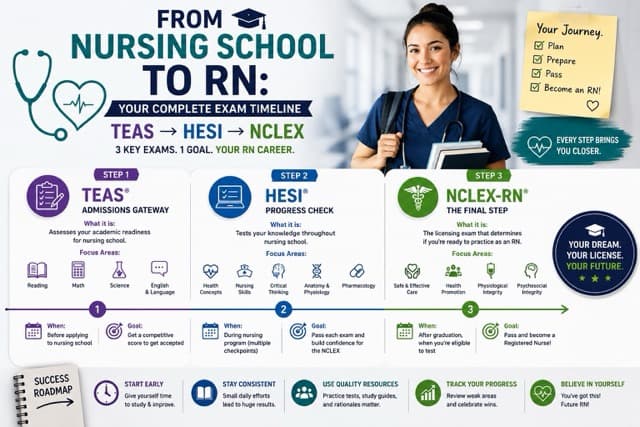
If you're mapping out your nursing exam timeline, you've probably realized pretty quickly that becoming an RN isn't just one exam - it's a whole sequence of them. TEAS to get in, HESI checkpoints throughout nursing school, then the NCLEX to actually earn your license. Each one matters. Each one has its own prep strategy. And if you don't know when they're coming, the whole journey can feel a lot more chaotic than it needs to be.
This guide lays out the complete nursing school exams sequence from start to finish - what each test is, when you take it, how long you'll typically spend preparing, and what score you need to move forward. Think of it as your roadmap to RN.
The Nursing Exam Journey: What You're Actually Signing Up For
Here's the honest picture: becoming a registered nurse requires passing multiple standardized exams at different stages of your education. There's no way around them. But knowing the full sequence ahead of time makes a real difference - both for planning your schedule and for keeping your stress manageable when each exam arrives.
The three main exams on your nursing career timeline are:
- TEAS (Test of Essential Academic Skills) - taken before nursing school to qualify for admission
- HESI (Health Education Systems Incorporated) - taken during nursing school, both as an entrance exam and as periodic progress checks
- NCLEX-RN (National Council Licensure Examination) - taken after graduation to earn your actual RN license
There are also program-specific exams and clinical competency assessments along the way, but those three are the major standardized milestones. Let's walk through each phase.
Phase 1: The TEAS Exam (Before Nursing School)
The TEAS is your entry ticket. Most nursing programs - whether you're going for an ADN or a BSN - require a competitive TEAS score as part of the admissions process. You'll typically take it during your prerequisite semester or while applying to programs.
What the TEAS Covers
The ATI TEAS 7 (the current version) tests four subject areas: Reading, Math, Science, and English and Language Usage. The Science section is what trips up most test-takers - it covers anatomy, physiology, biology, and basic chemistry. Total testing time is about 3.5 hours.
TEAS Score Requirements
Score benchmarks vary by school, but here's the general picture:
- Competitive programs (BSN): typically want 70%+, often 75-80% for selective schools
- Community college ADN programs: usually accept 65-70%, though this varies a lot by region
- Accelerated BSN programs: can require 75%+ and look at subscores too
Worth noting: you can retake the TEAS if needed, but most schools have a waiting period (typically 30 days) between attempts. Some limit the number of total attempts as well.
How Long to Prepare for the TEAS
Most students spend 4-8 weeks on TEAS prep if they're starting fresh. If your science prerequisites are recent and you're solid on the basics, 3-4 focused weeks can be enough. The key is honest self-assessment - figure out where your weak spots actually are before diving into generic study guides.
Need to pass the TEAS fast?
Our fast TEAS pass tutoring uses AI diagnostics to identify your specific weak areas, then expert tutors fix them in a single focused session. Pass guaranteed - or your money back.
Also available: expert TEAS exam support for students who need hands-on help.
Phase 2: HESI Exams (During Nursing School)
Here's something that catches a lot of nursing students off guard: HESI isn't just one exam. It shows up in different forms at different points in your nursing program, and each one serves a different purpose.
HESI A2 - The Entrance Exam
Some nursing programs use the HESI A2 instead of (or in addition to) the TEAS as their entrance exam. Like the TEAS, it tests academic readiness with sections on math, reading comprehension, vocabulary, grammar, and science. If your target school uses HESI A2 for admissions, you'll take it before starting the nursing program.
Not sure whether your school uses TEAS or HESI A2? Check the admissions requirements directly - plenty of schools accept either, and some require both.
HESI Mid-Curriculum and Specialty Exams
Once you're in nursing school, many programs use HESI specialty exams as checkpoints throughout the curriculum. You might see HESI exams at the end of foundational courses like pharmacology, medical- surgical nursing, pediatrics, OB, and mental health. These aren't optional - your program may require a minimum score to progress.
These mid-program HESI exams also serve as early predictors of NCLEX readiness, which is why programs take them seriously. A low score on a specialty HESI is often a signal to get targeted help before the gaps compound.
HESI Exit Exam
Near the end of your nursing program, you'll face the HESI Exit Exam - arguably the highest-stakes HESI of them all. Many schools require a passing score on the Exit Exam as a graduation requirement. It's designed to simulate the NCLEX and predict your likelihood of passing licensure.
The HESI Exit Exam score is also commonly used by nursing programs to decide whether a student gets clearance to take the NCLEX. Some schools require students to remediate and retest if they score below a threshold (typically 850 on the 1000-point scale). Don't treat this one casually.
Struggling with a HESI exam?
Our fast HESI pass tutoring covers both the HESI A2 and HESI Exit Exam. Same AI diagnostic + expert tutor approach - identify what's actually holding you back, fix it fast, pass guaranteed.
Phase 3: NCLEX-RN (After Graduation — Your Path to RN License)
The NCLEX-RN is the final gate between you and your RN license. It's administered by the National Council of State Boards of Nursing (NCSBN), and passing it is required in all 50 states. No NCLEX pass, no RN license - period.
When Do You Take the NCLEX?
After graduating from an accredited nursing program, you'll apply for licensure through your state's board of nursing and register with Pearson VUE to schedule your NCLEX-RN. The typical timeline looks like this:
- Graduate from nursing program
- Submit licensure application to your state board (2-4 weeks for processing, varies by state)
- Receive Authorization to Test (ATT) from Pearson VUE
- Schedule and take the NCLEX-RN (your ATT is valid for 60-90 days depending on state)
Most graduates aim to take the NCLEX within 45-60 days of graduation while the material is still fresh. Waiting too long is actually a common mistake - the longer you delay, the more you forget.
The NGN Format Change
If you're taking the NCLEX in 2024 or later, you're sitting the Next Generation NCLEX (NGN). The big change: more clinical judgment questions - things like case studies, bowtie questions, matrix grids, and trend/highlight items. These require you to apply nursing judgment, not just recall facts. Traditional NCLEX prep that's heavy on memorization won't cut it anymore.
Passing Standard and Attempt Limits
The NCLEX uses computerized adaptive testing (CAT), so every student gets a different number of questions - anywhere from 75 to 145 for most test-takers. There's no "magic number" of questions that means you passed. If you didn't pass on the first attempt, you'll need to wait 45 days before retesting (in most states).
Ready to pass the NCLEX on your first try?
Our fast NCLEX-RN pass tutoring is built specifically for the NGN format. AI diagnostics + clinical judgment coaching + pass guarantee. Most students need just one session.
Full Nursing Exam Timeline by Program Type
How long the whole journey takes depends heavily on which nursing program you're in. Here's a realistic breakdown by program type.
ADN (Associate Degree in Nursing) - Roughly 2-3 Years
Most ADN programs run 2 years of actual nursing coursework, but you'll spend a semester or more on prerequisites first. Your rough rn school timeline looks like this:
- Semester 1-2 (Prerequisites): Take TEAS or HESI A2 for admission
- Semesters 3-6 (Nursing Core): HESI specialty exams throughout
- Final semester: HESI Exit Exam
- 1-3 months after graduation: NCLEX-RN
BSN (Bachelor of Science in Nursing) - Roughly 4 Years
Traditional BSN programs include two years of general education before the nursing core. The exam milestones are similar to ADN but stretched across a longer program:
- Years 1-2 (Pre-nursing): TEAS or HESI A2 when applying to the upper-division nursing program
- Years 3-4 (Nursing Core): HESI specialty and progress exams throughout
- End of Year 4: HESI Exit Exam
- 1-3 months after graduation: NCLEX-RN
Accelerated BSN (ABSN) - 12-18 Months
ABSNs are intense by design. You already have a bachelor's degree in another field, so you move straight into nursing coursework. Score requirements tend to be higher (competitive programs often want TEAS scores of 75%+), and the pace of the program means HESI checkpoints come fast. The upside: you can be sitting for the NCLEX within 18 months of starting.
"The thing nobody told me before nursing school was that the exams don't stop once you get in. HESI checkpoints every few months kept me on my toes. But honestly, they were good practice - by the time I sat the NCLEX, it felt familiar."
- Danielle R., BSN graduate, Class of 2025
Tips for Each Stage of Your Nursing Exam Timeline
A few practical things that actually make a difference at each stage - not generic study advice, but stuff specific to how these exams work.
TEAS Tips
- Don't underestimate the Science section. Anatomy and physiology alone can make or break your score.
- Take at least two full-length practice tests under timed conditions before your real exam.
- ATI's official TEAS prep materials are worth using - they're written by the same people who write the test.
- If you've been out of school for a while, budget extra time for math. The TEAS math is manageable but rusty skills cost points.
HESI Tips
- Treat every HESI specialty exam seriously, not just the Exit. They compound - poor scores early signal gaps that will haunt you later.
- The HESI Exit Exam is your NCLEX dress rehearsal. Use it that way. Approach it with the same focus and time management you'd use on the real thing.
- Case study-style questions are increasingly common on HESI. Practice applying clinical judgment, not just memorizing drug names.
NCLEX Tips
- Start focused NCLEX prep at least 4-6 weeks before your scheduled date. Don't coast on nursing school momentum alone.
- For NGN questions, practice the clinical judgment model (NCSBN's framework) explicitly. It's a learnable skill, not just innate ability.
- UWorld and Archer are the most widely used NCLEX qbanks - both are solid, but they're only useful if you review your rationales carefully, not just rack up question counts.
- Don't reschedule your exam date unless you absolutely have to. Every extra week of waiting adds anxiety without adding much preparation value.
Wherever you are on your nursing exam timeline - we can help you pass the next one.
Frequently Asked Questions About the Nursing Exam Timeline
How many exams do you take in nursing school?
Between program-specific exams and standardized tests, nursing students typically face dozens of exams throughout their program. The major standardized ones are the TEAS (pre-admission), HESI specialty exams (during the program), the HESI Exit Exam (near graduation), and the NCLEX-RN (post-graduation). Most programs also have their own internal midterms and finals.
What is the order of nursing certification exams?
The standard order is: TEAS or HESI A2 (for admission) → HESI specialty exams throughout the program → HESI Exit Exam → NCLEX-RN. The nursing certification exams like specialty certifications (CCRN, CEN, etc.) come after you've been working as an RN for at least a year.
How long does the full nursing exam timeline take?
From taking your first TEAS to passing the NCLEX, the timeline ranges from about 18 months (accelerated BSN) to 3-4 years (traditional BSN with prerequisites). ADN programs typically fall in the 2.5-3 year range including prerequisites. The NCLEX is typically taken 1-3 months after graduation.
Do all nursing schools require the TEAS?
No - some schools use the HESI A2 instead, and a few accept either. Always check the specific admissions requirements for each program you're applying to. The admissions page on the nursing school's website will spell out which exam (or exams) they require.
What happens if you fail the HESI Exit Exam?
Policies vary by school, but most programs require students to remediate and retest. Some schools won't grant graduation clearance until you hit the minimum HESI Exit score. A few programs have mandatory remediation modules tied to your score. Check your program's specific policy - this is not an exam you want to be surprised by.
Can you take the NCLEX right after graduating nursing school?
Almost, but not quite. After graduation, you'll need to apply for licensure through your state board and wait for your Authorization to Test (ATT) from Pearson VUE before you can schedule the exam. That process typically takes 2-6 weeks. Most students take the NCLEX 4-8 weeks after graduation.
What's the best way to prepare for each nursing exam?
The most effective approach at any stage is diagnostic-driven prep - figuring out specifically what's holding your score back rather than studying everything generically. For the TEAS, ATI's official materials are a good baseline. For the HESI, focus on the specific subject areas your program covers. For the NCLEX, clinical judgment practice matters more than pure content review.
Your Next Step on the Path to RN License
The path to RN license runs through three major exam milestones - the TEAS, the HESI (in multiple forms), and the NCLEX. None of them are optional, and none of them are passable on vibes alone. But knowing the full nursing exam timeline ahead of time gives you a real advantage: you can plan, prepare intentionally, and avoid getting blindsided.
The students who struggle the most are usually the ones who treat each exam as a surprise rather than a known checkpoint. The ones who do well tend to start thinking about the NCLEX well before they're in their final semester - because every HESI specialty exam is practice for it.
Wherever you are right now on your nursing school timeline - preparing for the TEAS, midway through your program, or days away from the NCLEX - targeted prep beats generic studying every time. Know your weak spots, fix them specifically, and don't leave passing to chance.
Ready for your next nursing exam?
AI diagnostics + expert tutoring + pass guarantee. One session. Every nursing exam covered.
Related Nursing Exam Resources
Looking for deeper prep on any specific exam in your nursing timeline?
- Is the TEAS test hard? - What to actually expect and how to prepare
- HESI A2 study guide - Complete prep guide for the nursing entrance exam
- HESI vs TEAS - How the two entrance exams compare
- How to pass the NCLEX-RN on your first try - Strategies that actually work
- NCLEX-RN 4-week study plan - Week-by-week prep schedule
- Nursing entrance exams compared - TEAS vs HESI vs NLN side by side