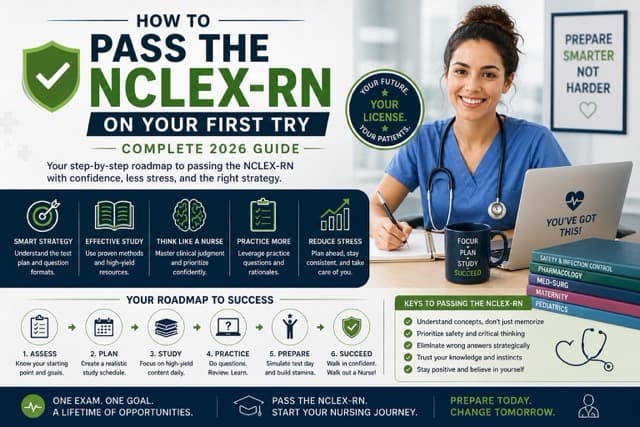
If you want to pass NCLEX first try, you need more than a giant question bank and a vague promise to study harder. The 2026 NCLEX-RN rewards clinical judgment, calm execution, and the ability to make safe nursing decisions when the question gets messy.
That sounds obvious, right? But a lot of nursing graduates still prepare like the exam is a straight content recall test. They reread notes. They watch long review videos. They answer hundreds of questions without slowing down to figure out why they missed the ones they missed. Then test day arrives, the adaptive format starts pushing back, and confidence gets shaky fast.
This NCLEX prep guide walks you through what matters in 2026: the current exam structure, the clinical judgment mindset, the NCLEX strategies that actually move your score, and a smarter way to prepare if your exam date is coming up soon. The goal is simple - help you walk into your first NCLEX-RN attempt with a system, not a pile of hope.
Why Your First NCLEX-RN Attempt Matters
Passing on the first try is not just an ego thing. Your NCLEX result affects licensure timing, job start dates, residency offers, and honestly, your mental bandwidth after nursing school. Nobody wants to graduate, celebrate for three days, and then spend the next two months trapped in retake anxiety.
So, do most people pass the NCLEX first time? For first-time U.S.-educated RN candidates, yes, a majority pass. But the exact NCLEX first time pass rate changes by year and candidate group, which is why the official NCSBN NCLEX Pass Rates dashboard is the place to check current numbers. It breaks results down by first-time versus repeater status and by domestic versus internationally educated candidates.
Here's the practical takeaway: don't let the overall pass-rate conversation make you casual. A good nursing program gives you the foundation, but your first attempt still needs focused prep. The NCLEX-RN is built to decide whether you can practice safely as a new nurse. That's a different task than getting through a final exam.
What Changed for the 2026 NCLEX-RN
The 2026 RN Test Plan is effective from April 1, 2026 through March 31, 2029, according to the official NCLEX test plans page. NCSBN updates test plans every three years so the exam keeps matching current entry-level nursing practice. In plain English: your prep should be aligned with the 2026 blueprint, not an old checklist floating around from before Next Generation NCLEX.
The NCLEX-RN still uses computerized adaptive testing, and NCSBN says the exam can include 85 to 150 items with a maximum time limit of five hours. That time includes the intro screen and breaks, so pacing is not a minor detail. It's part of the exam.
The biggest shift is still the Next Generation NCLEX emphasis on clinical judgment. NCSBN launched NGN in 2023 with the Clinical Judgment Measurement Model at the center of the exam. If you're trying to pass NCLEX on first try in 2026, you need to train how you recognize cues, analyze information, prioritize hypotheses, take action, and evaluate outcomes. Sounds like nursing, because it is.
2026 NCLEX-RN Snapshot
- Test plan cycle: April 1, 2026 through March 31, 2029
- Length: 85 to 150 items
- Maximum time: 5 hours, including breaks and intro screens
- Core skill: safe entry-level nursing clinical judgment
#1: Build Your Prep Around Clinical Judgment
The most important NCLEX RN tips are not little tricks. They're thinking systems. Start here: stop studying every missed question like it's just a fact you forgot. Sometimes it is. More often, you missed the question because your reasoning sequence broke down.
For example, a prioritization question might include four patients who all sound somewhat concerning. A weak test-taker hunts for a memorized keyword. A strong test-taker asks better questions: Who is unstable? Who has an airway, breathing, or circulation threat? What finding is unexpected for this condition? Which answer prevents the worst outcome right now?
That's the difference between content review and clinical judgment training. Content says, "I know what potassium does." Clinical judgment says, "This potassium level plus these symptoms means I need to intervene before choosing a teaching answer." That tiny shift wins points all over the NCLEX-RN.
Use Decision Trees, Not Loose Tips
Good NCLEX strategies are reusable. You should have decision trees for priority, delegation, infection control, pharmacology safety, lab values, and therapeutic communication. They don't need to be fancy. Actually, simple is better under pressure.
For priority questions, start with safety and instability. For delegation, separate assessment, teaching, evaluation, and unstable care from routine predictable tasks. For pharmacology, ask whether a finding is expected, therapeutic, adverse, or toxic. Don't just memorize a drug list and hope your brain retrieves the right line at question 112.
#2: Use a Diagnostic Before You Study More
If you've already done 500 questions and your score is barely moving, doing 500 more may not fix the problem. It might just reinforce the same bad habits. This is where a diagnostic earns its keep.
A useful diagnostic should tell you more than "weak in pharm" or "needs more maternity." It should show your score limiters. Are you missing questions because you don't know content? Because you misread stems? Because you panic on SATA? Because you change correct answers after second-guessing? Those are different problems, and they need different fixes.
This is exactly why our fast NCLEX-RN pass tutoring starts with AI diagnostics before the tutoring begins. The system looks for the highest-impact patterns, then your nurse-educator spends the session fixing those patterns. Not everything. Just the few things most likely to affect your pass result.
What to Track After Every Practice Set
After each block of questions, write down the reason for each miss: content gap, priority error, delegation error, clinical judgment sequence error, reading mistake, timing pressure, or anxiety. It takes five minutes. Maybe seven. But it turns a question bank from a scoreboard into a study tool.
Once you see the pattern, your prep gets calmer. You don't need to relearn all of nursing school. You need to fix the three or four habits that keep turning knowledge into wrong answers.
#3: Practice NGN Question Types the Right Way
Next Generation NCLEX questions can feel strange at first. Case studies, matrix items, extended multiple response, bow-tie style logic, highlight questions - they ask you to manage information instead of simply recognizing a fact. That's why random question grinding doesn't always work.
When you practice NGN items, slow down during review. Ask: Which cues mattered? Which details were distractors? Did I prioritize the right hypothesis? Did I pick an intervention because it sounded familiar, or because it matched the patient's immediate risk?
SATA questions deserve special attention too. The trap is treating them like a guessing contest. Better approach: evaluate each option independently as true or false, then check whether the group of selected answers actually matches the question's requested action. It sounds basic. Under stress, basic systems save you.
"I knew nursing content, but NGN case studies made me overthink everything. The session gave me a repeatable cue-to-action process. That was the difference."
- Rachel P., NCLEX-RN first-attempt candidate
#4: Train Pacing for the CAT Format
The NCLEX is not a normal school test where every student sees the same fixed set of questions. Computerized adaptive testing can feel emotionally weird because you don't know whether harder questions mean you're doing well, doing poorly, or simply moving through the algorithm. So don't try to read the exam's mood. It doesn't have one.
Your job is to answer the question in front of you. Keep your pace steady, use breaks intentionally, and don't spiral if the exam goes beyond the minimum number of items. Passing at 85 is great. Passing at 150 is still passing. The item count is not your score report.
A Simple Pacing Rule
Because the exam can run up to five hours, practice with a calm average pace instead of sprinting. If a question is long, read it carefully once, identify the task, choose using your clinical framework, and move. If you are stuck between two answers, ask which one is safest for the patient now. Then commit.
This is one reason repeat practice under timed conditions matters. You aren't just learning facts. You're teaching your nervous system that NCLEX-style pressure is familiar.
Fast-Track Your NCLEX-RN Prep with 1-Hour Tutoring
Some students have eight weeks. Some have eight days. If your exam is close and you need to pass NCLEX first try, the fastest route is targeted correction, not more broad review.
ParityX NCLEX-RN tutoring uses a focused one-hour model: diagnostic first, nurse-educator coaching second, clinical Flight Plan last. The session targets the decision patterns that cost you points - priority, delegation, pharm safety, labs, infection control, NGN case logic, timing, or second-guessing.
If your issue is broader than NCLEX-RN alone, our fast nursing exam pass tutoring covers nursing school exams, NCLEX-PN, bridge-program tests, and other clinical judgment-heavy assessments. Same idea: find the bottleneck, fix the pattern, leave with a plan you can use under pressure.
What the One-Hour Session Focuses On
- Clinical judgment frameworks for NGN and traditional items
- Priority and delegation decision trees
- SATA and matrix-item elimination strategy
- Pharm safety and lab-value intervention logic
- Timed practice with reset routines for anxiety and fatigue
Is one hour magic? No. It's focused. That's the point. If you're close to passing but stuck in scattered prep, a precise intervention can do more than another week of unfocused review.
Need a first-attempt NCLEX-RN plan before test day?
Start NCLEX-RN Tutoring NowOfficial NCLEX-RN Resources to Use
Use official resources as your anchor. The 2026 NCLEX-RN Test Plan should guide what you study, because it outlines content categories, clinical judgment expectations, and sample item information. It's not light beach reading, but it's worth scanning.
Also review the official NCLEX pages on exam format and rules. The NCSBN help center confirms the 85 to 150 item range and the five hour time limit, and the retake guidance explains the standard 45-day waiting period between attempts, though state nursing boards can impose stricter rules. Hopefully you won't need that retake information. Still, knowing the rules lowers the drama.
If you're earlier in the nursing pathway, you may also find our guides on passing the TEAS, HESI A2 prep, and nursing entrance exams useful. NCLEX prep starts long before graduation, even if most students don't realize it at the time.
Frequently Asked Questions About Passing the NCLEX First Try
How do I pass NCLEX first try?
To pass NCLEX first try, build your prep around clinical judgment, not memorization alone. Use diagnostics to find your weak patterns, practice NGN question types, review every missed question by reason, and train pacing under timed conditions. If your exam is close, targeted tutoring can help you fix the highest-impact issues quickly.
What percent of people pass NCLEX first try?
The NCLEX first attempt pass rate depends on the year and candidate group. First-time U.S.-educated RN candidates usually have a much higher pass rate than repeat or internationally educated groups. For the exact current percentage, use the official NCSBN pass-rate dashboard, which updates by year and candidate type.
Do most people pass the NCLEX first try?
Yes, most first-time U.S.-educated RN candidates pass, but "most" doesn't mean automatic. Students who rely only on passive review can still struggle, especially with NGN case studies and clinical judgment questions. Treat your first attempt seriously.
How many questions are on the NCLEX-RN in 2026?
According to NCSBN, the NCLEX-RN can include anywhere from 85 to 150 items. The maximum time limit is five hours, including the introductory screen and breaks. Don't panic if your exam continues past the minimum. Item count alone doesn't tell you whether you passed.
What are the best NCLEX strategies for NGN questions?
The best NGN NCLEX strategies are cue recognition, priority sorting, hypothesis testing, safe action selection, and outcome evaluation. For case studies, identify the important cues before looking at answer choices. For SATA and matrix items, judge each option independently instead of guessing based on how many answers "feel" right.
Can I pass NCLEX-RN with only two weeks to study?
Maybe, depending on your baseline. If you recently graduated, have solid content knowledge, and mostly need clinical judgment structure, two focused weeks can be enough. If you have major content gaps, you need a tighter plan and probably expert help. Start with a diagnostic before choosing what to study.
What if I didn't pass NCLEX the first time?
Failing the first attempt feels awful, but it is fixable. Review your Candidate Performance Report, identify whether the issue was content, clinical judgment, timing, or anxiety, and rebuild your prep around that pattern. NCSBN guidelines include a 45-day waiting period between attempts, but your nursing regulatory body may have stricter rules.
Your NCLEX-RN First Attempt Deserves a Real Plan
AI diagnostics, nurse-educator coaching, and a focused clinical judgment Flight Plan for test day.
Book Your NCLEX-RN SessionYour First-Try NCLEX-RN Plan
Passing the NCLEX-RN on your first try comes down to preparation quality. Study the current 2026 test plan. Practice NGN items until the format feels normal. Track why you miss questions. Build simple decision trees for the clinical situations that show up again and again.
And if you're close to test day, don't waste your remaining time on random review. Use diagnostics, fix the patterns that cost you points, and walk in with a repeatable strategy. That's how you pass NCLEX first try without turning your life into one long panic-study session.
Related Nursing Exam Resources
Keep building your nursing exam plan with these ParityX resources:
- Fast NCLEX-RN pass tutoring - focused help for NGN and clinical judgment
- Fast nursing exam pass tutoring - nursing school, NCLEX-PN, and specialty exam support
- TEAS test study guide - nursing entrance exam prep for applicants
- HESI vs TEAS comparison - choose the right nursing entrance exam path
- Nursing entrance exams compared - TEAS, HESI, NLN, and nursing pathway planning