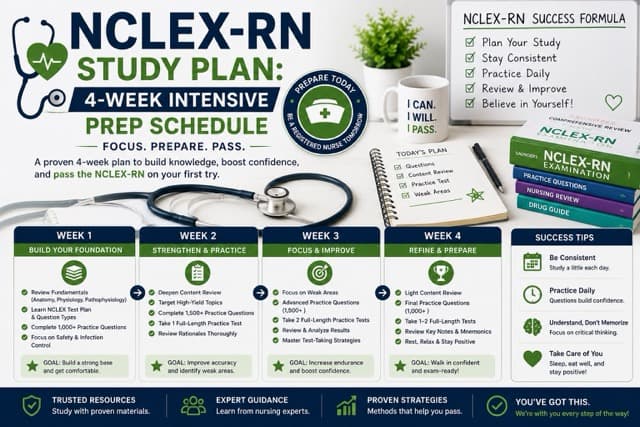
You just finished nursing school. You're exhausted, maybe a little terrified, and someone just handed you a NCLEX study plan that stretches across three months of your life. Here's the thing - you probably don't need three months. A focused, well-structured 4-week NCLEX study plan works for most recent nursing grads, especially when you actually follow it.
This schedule covers everything: how to build your NCLEX study schedule week by week, which resources are actually worth your time (UWorld, Archer, ATI, and a few others), how to handle Next Generation NCLEX (NGN) question formats, and what to do when you're running out of steam in week three. It's not a perfect plan - no plan survives contact with real life - but it's a solid one.
If you're looking for the best NCLEX study plan that doesn't have you reading textbooks until 2 AM every night, this is it. Let's break it down.
How Long Should You Actually Study for the NCLEX?
Honest answer? It depends on when you graduated and how much nursing school material you retained. Most nursing students who sit for the NCLEX within 30-60 days of graduation pass at significantly higher rates than those who wait six months or longer. Your clinical knowledge is freshest right now - don't let it fade.
The popular NCLEX prep timelines range from 1 week (risky) to 3 months (usually overkill). Four weeks hits the sweet spot for most people. You get enough time to cover content gaps and do meaningful question practice without losing momentum or burning out before you ever sit the exam.
That said, here's what actually matters more than total weeks: daily consistency. Four weeks of 4-5 hours per day beats six weeks of sporadic cramming every single time. So before you start, be honest with yourself about your schedule. If you're working part-time or have major life obligations, you might stretch this to 6 weeks instead - and that's completely fine.
Before You Start: Take a Diagnostic
Don't skip this. Take a baseline practice exam (75 questions, timed) before you begin week one. This tells you where your actual weak spots are, not the ones you're worried about. Most students are surprised - the areas they dreaded (pharmacology, for instance) aren't always the ones dragging their scores down. Your diagnostic results should shape everything that follows.
Week 1: Foundation Building and Diagnostic
Week one is about orientation, not exhaustion. You're setting up systems, identifying gaps, and getting comfortable with the NCLEX question format - especially the NGN case studies that now make up a significant chunk of the exam.
Week 1 Daily Schedule (4-5 hours/day)
By the end of week one, you should know your top three weak content areas. Write them down. These become your priority targets for the rest of the plan.
Week 2: Core Content Deep Dive
Week two is the heaviest content week. You're going through pharmacology, mental health, maternal-newborn, and pediatrics - the areas that tend to have the highest volume of questions and the most room for improvement. Don't try to memorize everything. Focus on patterns.
Week 2 Daily Schedule
The mid-point exam on day 14 is important - don't skip it. If your score hasn't improved from week one, it usually means you're reviewing content passively instead of practicing actively. The fix: do fewer content reviews and more question rationale analysis.
"I wasted week two reading Saunders cover to cover. I passed on my second attempt after I switched to question-based studying. The rationales taught me more in three days than the textbook did in two weeks."
- Recent NCLEX passer, nursing community forum
Week 3: NGN Question Practice and Weak Area Targeting
Week three is where your NCLEX prep plan either works or falls apart. Most people either get overconfident (big mistake) or start spiraling about failing (equally bad). Neither mindset helps you.
The main focus here is Next Generation NCLEX format questions. If you're taking the exam in 2025 or 2026, you'll encounter case studies, extended multiple response, matrix questions, and bow-tie clinical judgment questions. These aren't impossible - they're just different. You need dedicated practice to get comfortable with them.
Week 3 Daily Schedule
A quick note on resources for week three: Archer Review tends to be particularly strong for NGN-style questions. Their adaptive interface gives you a real-time sense of where you stand, which is genuinely useful when you're trying to calibrate your readiness. The Archer NCLEX study plan built into their platform can also supplement this schedule if you want extra structure.
Week 4: Final Review, Full Simulations, and Exam Readiness
Week four is not the time to learn new content. Seriously - if you haven't studied something by now, cramming it in the last few days will create anxiety without meaningfully improving your score. This week is about reinforcing what you know and building test-day confidence.
Week 4 Daily Schedule
The two-day wind-down before the exam matters more than people realize. You're not going to dramatically improve your score in those final 48 hours. What you can do is show up rested, calm, and mentally sharp - and that actually does make a measurable difference in performance on a high-stakes adaptive exam like the NCLEX.
Best NCLEX Study Resources to Use with This Plan
You don't need every resource. Pick 2-3 and go deep. Here's what's actually worth your time and money for a 4-week NCLEX study plan:
UWorld NCLEX - Best for Question Practice
If you only buy one resource, make it UWorld. Their question quality is exceptional, the rationales are genuinely educational (not just answer explanations), and the interface closely mirrors what you'll see on test day. The built-in UWorld NCLEX study plan feature helps you track your performance by category over time. One subscription gets you access to 2,000+ practice questions - more than enough for four weeks.
Archer Review - Best for NGN and Adaptive Testing
Archer has become the go-to resource for NGN case study practice. Their adaptive algorithm adjusts question difficulty based on your performance, which is closer to how the actual NCLEX CAT algorithm works. The Archer NCLEX study plan templates are also solid if you want pre-built schedules rather than building your own.
Mark Klimek Audio Lectures - Best Free Supplement
The Mark Klimek NCLEX lectures have been around forever and they're still worth it - especially for mental health, fluids and electrolytes, and acid-base balance. They're free on YouTube, take about 12 total hours to get through, and cover high-yield content in a memorable way. A lot of nurses swear by them even today.
Simple Nursing - Best for Visual Learners
If you struggle to retain pharmacology and pathophysiology through reading alone, Simple Nursing's video content makes concepts stick. Their mnemonics are a bit silly, but that's kind of the point. The Simple Nursing NCLEX study plan videos pair well with active question practice.
When Self-Study Isn't Enough
Some test-takers hit a wall - their practice scores plateau, their confidence tanks, or they just can't figure out why they keep missing certain question types. That's not a failure of effort; it's a signal that self-guided study isn't addressing the right things. Expert intervention often fixes in one focused session what weeks of solo studying can't crack.
Stuck on a plateau? There's a faster way.
1 Hour. AI Diagnostics. Expert NCLEX Tutor. Pass Guarantee.
Our fast NCLEX-RN pass tutoring uses AI to identify exactly what's limiting your score, then an expert tutor fixes it in one focused session - pass guarantee included. If you don't pass, you get a full refund.
Learn more about our NCLEX-RN tutoring service →Expert Tips to Maximize Your NCLEX Study Schedule
Beyond the week-by-week structure, a few strategies make an outsized difference in how well your NCLEX study schedule actually translates to exam performance.
Do Questions First, Then Review Content
This might feel backwards, but it works. Start each study session with a 25-30 question set. When you miss a question, that's the signal to go review that specific content. This approach makes your content review targeted and relevant, rather than passive reading of stuff you might already know.
Track Your Weak Patterns, Not Just Wrong Answers
There's a difference between missing a question because you didn't know the content and missing it because you misread the stem, fell for a distractor, or rushed. Keep a running log of why you're getting questions wrong. You'll often discover that a surprisingly large percentage of your errors come from execution patterns rather than knowledge gaps.
Understand the Clinical Judgment Framework for NGN
For Next Generation NCLEX questions, NCSBN uses a specific clinical judgment model: recognize cues, analyze cues, prioritize hypotheses, generate solutions, take action, and evaluate outcomes. You don't need to memorize this like a script, but understanding the framework helps you approach case studies systematically instead of guessing based on vibes.
Don't Change Your Test Strategy Mid-Exam
This is a big one. The NCLEX CAT algorithm adapts to your performance, which means the exam gets harder when you're doing well and easier (relatively) when you're struggling. A lot of candidates panic mid-exam when questions feel difficult and start second-guessing everything. Hard questions are actually a positive sign - it means the algorithm thinks you're doing well. Trust your preparation.
Build in Sleep and Recovery Intentionally
Sleep isn't optional - it's where memory consolidation actually happens. Studies on exam performance consistently show that sleep-deprived students perform worse even when they've studied more total hours. Eight hours of sleep will outperform two extra study hours almost every time.
Frequently Asked Questions About NCLEX Study Plans
Is a 4-week NCLEX study plan enough?
For most recent nursing graduates, yes. The 4-week NCLEX study plan works well for candidates who graduated within the last 2-3 months and are studying 4-5 hours daily. If you're working full-time or graduated more than 6 months ago, consider extending to 6-8 weeks. The key variable isn't total weeks - it's total focused study hours and how well you target your specific weak areas.
How many hours a day should I study for the NCLEX?
Four to five hours of focused, active study per day is the sweet spot for most people. Beyond that, you hit diminishing returns fast - your retention drops and you accumulate mental fatigue that carries into the next session. Quality matters way more than quantity here. Two hours of active question practice with careful rationale review beats five hours of passive reading.
What's the best NCLEX study plan for UWorld users?
If you're using UWorld, integrate it throughout all four weeks rather than front-loading or saving it for the end. Use UWorld's built-in performance analytics to identify your weak categories weekly. The UWorld NCLEX study plan feature inside the platform can generate a personalized schedule based on your qbank performance - this complements the framework above well.
Can I follow this NCLEX study plan with Archer?
Absolutely. Archer is especially strong in weeks 3-4 when you're doing NGN case study practice and adaptive simulations. The Archer NCLEX study plan content maps well to this framework - use their adaptive quizzing during content review weeks and their full-length simulations as your week four practice exams.
What if my practice scores are still low going into week 4?
First - don't panic. Practice test scores don't perfectly predict NCLEX performance, and score plateaus are common. Review whether you're actively analyzing rationales or just noting right vs. wrong. If you're genuinely stuck, an expert NCLEX tutor can often identify the specific patterns holding your score back much faster than continued solo study can.
Should I use a printed or digital NCLEX study plan?
Use whatever you'll actually follow. Some people swear by printed calendars on their wall; others track everything digitally. The format matters way less than consistency. What matters is that you have a clear daily plan, you follow it most days, and you adjust when life gets in the way (because it will).
Want to shortcut 4 weeks into 1 hour? Book a guaranteed NCLEX-RN tutoring session.
Get Your Guaranteed NCLEX Pass Now →Your 4-Week NCLEX-RN Study Plan Starts Today
Here's the summary: start with a diagnostic, spend week one on foundations, go deep on content in week two, shift to NGN practice and weak area targeting in week three, and use week four to simulate and reinforce. Take actual rest days. Do questions every single day. Analyze your rationales. Track patterns, not just scores.
The NCLEX study plan that actually works isn't the most elaborate one or the most expensive one - it's the one you execute consistently. Four weeks is enough. You know more than you think you do. Trust your nursing school training, fill the actual gaps, and go pass this thing.
And if you hit a wall - if your scores plateau or you're losing confidence with two weeks left - don't just grind harder. Get targeted help. Our NCLEX-RN tutoring service uses AI diagnostics to identify exactly what's limiting your score and addresses it in one focused session, with a pass guarantee backed by a full refund if it doesn't work. Sometimes the smartest study decision is knowing when to ask for help.
Your NCLEX Pass Is 4 Weeks Away
Follow the plan. Trust the process. Pass the first time.
Start Your NCLEX-RN Tutoring Session →Related NCLEX and Nursing Exam Resources
More guides to help you navigate the full nursing exam journey:
- How to pass the NCLEX-RN on your first try - complete 2026 guide with test-day strategies
- HESI A2 study guide - prep for nursing school admission exams
- Nursing entrance exams compared - HESI vs. TEAS vs. other nursing school tests
- Fast nursing exam pass tutoring - guaranteed prep for any nursing exam