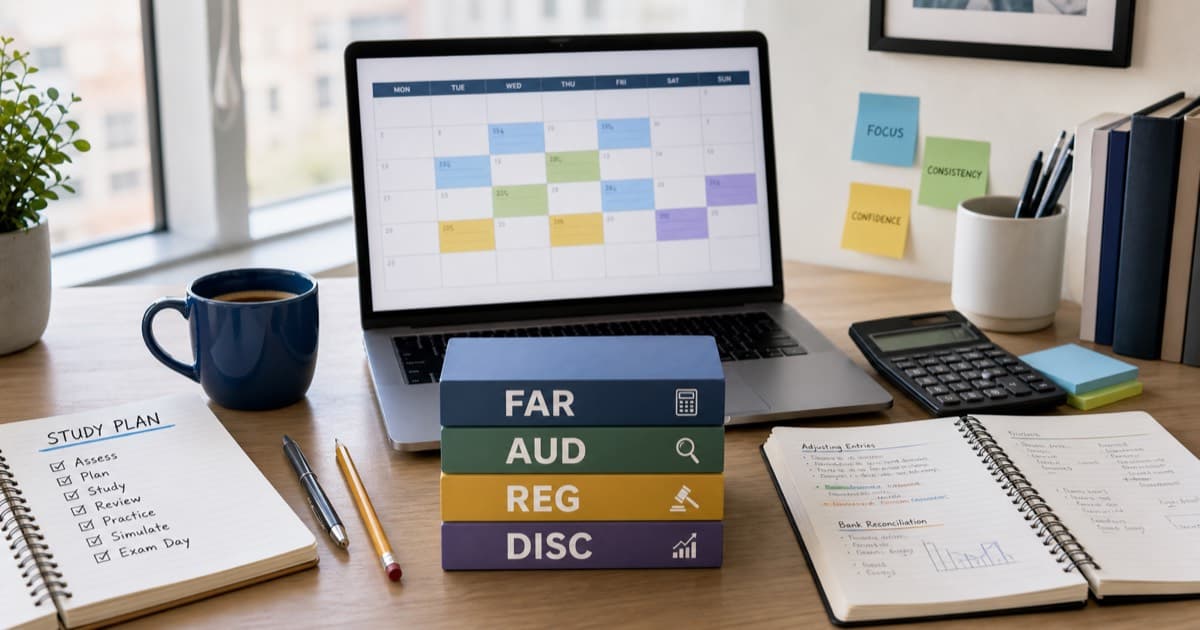
A good CPA study plan does more than tell you to “study FAR for 8 weeks” and hope for the best. It tells you which section to take first, how many hours to budget, when to book your exams, what to do after a weak practice test, and how to keep going when work gets messy. Because it will get messy.
The CPA exam is now built around three Core sections - FAR, AUD, and REG - plus one Discipline section: BAR, ISC, or TCP. Each section is four hours, and the full exam is a 16-hour project. That means your plan can't just be a motivational calendar. It needs to account for content weight, score-release timing, the 30-month credit window, and your actual life outside of exam prep.
This CPA prep guide lays out a practical way to pass all four sections in 2026, including a 6-month accelerated plan, a working-professional schedule, section-by-section tactics, and the study mistakes that make smart candidates fail. If you need targeted help at any point, our fast CPA pass tutoring can diagnose the exact topics holding your score down before you waste another month grinding the wrong material.
Start With the 2026 CPA Exam Structure
Before you build a study plan for the CPA exam, you need to know what you're planning around. The AICPA CPA Exam Blueprints are the official source for what gets tested. For 2026, every candidate must pass:
- FAR - Financial Accounting and Reporting: financial statements, select transactions, state and local governments, and reporting frameworks.
- AUD - Auditing and Attestation: ethics, risk assessment, evidence, reporting, and professional responsibilities.
- REG - Taxation and Regulation: federal taxation, entity taxation, individual taxation, business law, and ethics.
- One Discipline section: BAR, ISC, or TCP, depending on your background and career path.
The exam still uses two major item types: multiple-choice questions and task-based simulations. The AICPA states that each section has five testlets: two MCQ testlets followed by three simulation testlets. Most sections are weighted 50% MCQs and 50% simulations, while ISC is weighted 60% MCQs and 40% simulations.
Translation? You can't pass by only drilling MCQs. You need simulation practice from the beginning, especially on FAR and REG. A lot of candidates ignore TBSs until the final week because simulations feel slow and annoying. Honestly, that's exactly why they matter. The slow stuff is where the exam exposes shallow knowledge.
Quick reality check:
A CPA study calendar should include three kinds of work every week: concept review, MCQ drills, and simulation practice. If one of those is missing, your plan is probably too fragile.
Best CPA Exam Section Order for Most Candidates
There's no perfect CPA study order for every candidate. Your job experience matters. Your degree program matters. Busy season matters. Still, for most candidates, the best order is:
- FAR first - widest content base and the section most likely to need a longer runway.
- AUD second - builds nicely after FAR because audit questions assume financial reporting fluency.
- REG third - tax-heavy, more memorization, and easier to isolate once FAR/AUD are behind you.
- Discipline fourth - choose BAR, ISC, or TCP based on your strengths and career direction.
That sequence works especially well if you're early in your accounting career and don't have a strong tax or systems background yet. Starting with FAR gives you the longest possible credit window after passing the section most people fear.
When You Should Change the Order
If you work in tax, start with REG and take TCP as your Discipline. You already have the context, and your day job can double as reinforcement. If you're in IT audit, systems, SOC reporting, or cybersecurity-adjacent work, AUD into ISC can make more sense. If you're strong in financial analysis, consolidations, and managerial accounting, FAR into BAR may feel more natural.
The rule is simple: start with either the hardest section for your background or the section where you already have momentum. What you shouldn't do is choose randomly because a Reddit thread said someone passed TCP in 19 days. Maybe they did. Good for them. That doesn't make it your plan.
If you're unsure, take one diagnostic across all four paths before locking your order. A licensed CPA tutor can usually spot the best sequence faster than you can by reading another dozen forum posts.
6-Month CPA Study Plan to Pass All 4 Sections
A 6 month CPA study plan is aggressive, but it is realistic if you can study 15-20 focused hours per week. That usually means five shorter weekday sessions plus one longer weekend block. It is not glamorous. It works.
Here's the big picture:
| Timeline | Section | Weekly Focus | Target Hours |
|---|---|---|---|
| Weeks 1-7 | FAR | Financial reporting, bonds, leases, consolidations, NFP/governmental, TBSs | 120-140 |
| Weeks 8-12 | AUD | Audit risk, evidence, reports, SSARS/SSAE, professional judgment | 80-100 |
| Weeks 13-18 | REG | Individual tax, entity tax, property transactions, basis, business law | 90-110 |
| Weeks 19-24 | BAR, ISC, or TCP | Discipline-specific content, weak-area drills, final simulations | 80-110 |
Notice that FAR gets the longest runway. That's intentional. Based on recent AICPA pass-rate data, FAR remains one of the lowest-pass-rate sections, and BAR has also been challenging under CPA Evolution. You don't need to be scared of that, but you do need to budget time honestly.
What Each Study Block Should Look Like
Each section should move through four phases:
- Foundation: watch or read core lessons, build notes, and understand the blueprint areas.
- Active recall: daily MCQs, short written explanations, and flashcards for rules you keep missing.
- Simulation training: TBS practice twice per week at first, then more heavily near review time.
- Final review: cumulative sets, timed practice, weak-area repair, and one full mock exam if your platform offers it.
Don't wait until you “finish the book” to start mixed review. The CPA exam punishes forgotten material. If you study bonds in week two and don't touch them again until week seven, you'll feel like you're relearning from scratch. That is one of the sneakiest ways a CPA study plan falls apart.
CPA Study Plan While Working Full Time
Most CPA candidates are not full-time students. They're staff accountants, auditors, tax associates, controllers, analysts, or career changers trying to study after work when their brain already feels cooked. So yes, a CPA study plan while working has to be different.
A realistic weekly schedule looks like this:
- Monday: 60-75 minutes of new content and 20 MCQs.
- Tuesday: 60 minutes of MCQs plus written review of every missed question.
- Wednesday: 75-90 minutes of new content and one short simulation.
- Thursday: mixed MCQ set, flashcards, and one weak topic repair.
- Friday: light review only, or take it off if work was brutal.
- Saturday: 3-4 hour deep session with simulations and cumulative review.
- Sunday: 2-3 hours of planning, MCQs, and catching the topics you avoided all week.
That gives you about 12-16 hours per week without pretending you'll become a different human overnight. If you're in busy season, cut the plan down to maintenance mode: 30-45 minutes per day, mostly review and MCQs, then restart heavier studying once your workload drops. Consistency beats heroic bursts.
Working full time and stuck on the same CPA section?
Our AI diagnostic pinpoints your weakest CPA topics, then a licensed CPA tutor focuses your next study block on the highest impact fixes.
Get Targeted CPA Tutoring →Section-by-Section CPA Prep Guide
Your CPA study schedule should not treat every section the same. FAR, AUD, REG, BAR, ISC, and TCP reward different skills. Same exam family, very different personalities.
FAR Study Plan
FAR is broad, technical, and easy to underestimate if you were good at financial accounting in school. Plan for 120-150 hours if you are starting from a normal accounting background. Spend extra time on consolidations, leases, bonds, income taxes, statement of cash flows, and governmental/NFP accounting.
A strong CPA FAR study plan includes TBS practice early because FAR simulations can combine multiple topics in one problem. You're not just memorizing rules - you're building accounting muscle memory.
AUD Study Plan
AUD feels less calculation-heavy, which tricks some candidates into studying it too passively. Don't. AUD questions often turn on wording: most likely, least likely, sufficient, appropriate, significant deficiency, material weakness. Tiny language differences matter.
For an audit CPA study plan, drill risk assessment, assertions, audit evidence, reports, independence, and SSAE/SSARS differences. Write down why wrong answers are wrong. That one habit will do more for AUD than rereading chapters with a highlighter.
REG Study Plan
REG is tax plus business law, and the tax portion rewards repetition more than inspiration. You need basis rules, entity taxation, individual deductions, property transactions, and penalties to feel automatic. If you work in tax, good news: REG may become your confidence section. If you don't, budget 90-120 hours.
Your CPA REG study plan should include quick daily review of formulas and thresholds, but don't overdo rote memorization. Learn how the rules move through examples. REG is much easier when you can see the story behind the numbers.
BAR, ISC, or TCP Study Plan
Your Discipline section should match your strongest lane whenever possible:
- BAR: best for candidates who like analysis, financial reporting depth, budgeting, and performance management.
- ISC: best for IT audit, controls, systems, data, SOC reporting, and security-minded candidates.
- TCP: best for candidates with tax experience or a strong interest in planning and compliance.
If you're choosing purely by pass rates, slow down. Pass rates partly reflect who chooses each discipline. TCP has had high pass rates, but many TCP candidates already work in tax. BAR has had lower pass rates, but it also attracts candidates tackling technically dense accounting topics. Choose the path you can study deeply, not the one that looks easiest in isolation.
How to Build Your 2026 CPA Exam Schedule
Your CPA exam schedule matters almost as much as your content plan. According to AICPA's 2026 score-release guidance, Core sections are released throughout the year on a rolling schedule, while Discipline sections are administered during the first month of each quarter. That one detail should shape your calendar.
The AICPA 2026 score-release schedule lists Core score-release target dates across the year and Discipline windows in January, April, July, and October. Build your Discipline prep backward from those windows. If you miss one, you may wait until the next quarter.
A Simple 2026 Schedule Example
- January-February: study FAR, test late February or early March.
- March-April: study AUD, test in late April.
- May-June: study REG, test near late June.
- July: sit for your Discipline section if ready, or use July/August for heavier prep and test in October.
That schedule is ambitious but clean. A more conservative candidate could stretch the same structure across 9-12 months, especially if work travel, busy season, family responsibilities, or retakes are in the picture.
NASBA also notes that score timing depends on when AICPA receives your exam file from Prometric, and sitting on a cutoff date does not guarantee a specific release date. In plain English: don't build a plan where one delayed score wrecks everything.
Best CPA Study Materials and Support
The best CPA study material options usually combine four things:
- A full review course: Becker, UWorld, Surgent, Gleim, Ninja, or another reputable platform with updated 2026 content.
- The AICPA Blueprints: not as a textbook, but as your official map of what can be tested.
- Practice questions: daily MCQs plus simulations, not occasional cram sessions.
- Targeted support: tutoring or diagnostics when your scores stop improving.
A review course is useful, but it isn't magic. Most courses are built to cover everything. Your job is to figure out what you personally need. That's where diagnostics matter. Two candidates can both score 62 on FAR and have completely different problems - one may be weak on governmental accounting, another on simulations, another on time management.
If you've already failed a section, read our breakdown of how hard the CPA exam really is before you restart. It explains why more hours alone don't always produce a better score.
Common CPA Study Plan Mistakes
Watch out for these. They're common because they feel productive in the moment.
- Watching too many lectures: lectures are input, not proof that you can answer exam questions.
- Ignoring simulations: TBSs expose whether you can apply concepts when the format gets messy.
- Overstudying strengths: comfortable topics feel good, but they rarely lift your score enough.
- Skipping cumulative review: the exam is cumulative even when your study calendar pretends it isn't.
- Refusing help too long: one focused tutoring session can save weeks of spinning in circles.
Frequently Asked Questions About CPA Study Plans
How long should I study for the CPA exam?
Most candidates need roughly 350-500 total study hours across all four sections, depending on background, review course quality, and how efficiently they study. FAR often needs the most time, while AUD and Discipline timing depends heavily on your work experience.
How many hours should I study for each CPA exam section?
A realistic starting point is 120-150 hours for FAR, 80-100 for AUD, 90-120 for REG, and 80-110 for your Discipline section. If you're already strong in tax, audit, systems, or reporting, you may need less time for the matching section.
Can I pass all 4 CPA sections in 6 months?
Yes, but only if you can study consistently and schedule exams tightly. A 6-month plan usually requires 15-20 focused hours per week and very little downtime between sections. If you're working full time during busy season, 9-12 months may be more realistic.
What are the 4 CPA exam sections in 2026?
The four sections are FAR, AUD, REG, and one Discipline section. The Discipline options are BAR, ISC, and TCP. The old BEC section is gone under CPA Evolution, so make sure your study materials match the current exam.
Which CPA exam section should I take first?
FAR is the best first section for many candidates because it is broad and foundational. But if you work in tax, REG first can make sense. If you work in audit or systems, AUD or ISC may be a better opening move. Pick based on your background, not someone else's calendar.
Should I use a CPA study plan template or build my own?
A template is useful for structure, but your plan should be adjusted after your first diagnostic and first few practice sets. The best CPA study plan is specific: it names the topics you miss, the days you'll review them, and the exam date you're working toward.
What if I already failed one CPA section?
Don't just repeat the same course from the beginning. Read your performance report, identify whether the issue was content, simulations, timing, or question interpretation, and rebuild your study plan around that. This is where targeted CPA tutoring can be especially valuable.
Stop Studying Everything. Start Studying What Moves Your Score.
AI diagnostics + licensed CPA tutoring + section-specific prep = a smarter CPA study plan for 2026.
Build Your CPA Pass Plan →Your CPA Study Plan Should Be Strategic, Not Heroic
Passing the CPA exam in 2026 is not about becoming the person who studies until midnight every night and survives on panic. That story sounds dramatic, but it's a bad operating system. A better CPA study plan is boring in the best way: scheduled, specific, diagnostic, and honest about your weak areas.
Start with the official exam structure. Pick a section order that matches your background. Give FAR enough time. Practice simulations early. Schedule around the actual 2026 score-release windows. And when your practice scores flatten, don't take it personally - get more precise.
The candidates who pass all four sections usually aren't the ones with unlimited time. They're the ones who make better decisions with the time they have. If your current plan feels like a foggy mix of lectures, MCQs, and guilt, tighten it up. The CPA exam rewards clarity.
Need help figuring out what to fix first? Start with fast CPA pass tutoring and get a section-specific diagnostic before your next exam date. One focused session can save you from weeks of studying the wrong thing.
Related Exam Prep Resources
Planning more professional certification prep? These resources pair well with this CPA guide:
- Fast CPA Pass Tutoring - AI-powered diagnostics with licensed CPA tutors
- How Hard Is the CPA Exam? - pass rates, difficulty, and section-by-section breakdown
- Fast CFA Pass Tutoring - finance certification support for analysts and portfolio professionals
- PMP Exam Study Plan - 3-month schedule for project management certification
- CompTIA Security+ Study Plan - another professional certification schedule built for working candidates
All ParityX exam prep services use focused diagnostics and expert tutoring to cut through generic study advice. The goal is simple: find the highest-impact score gaps and fix those first.