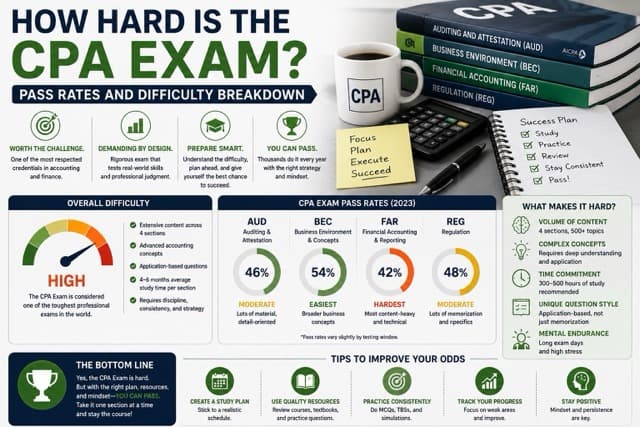
How hard is the CPA exam? It's the first question every aspiring accountant asks - and honestly, the answer is a little uncomfortable. The CPA exam is legitimately one of the hardest professional credentialing exams in existence. The numbers don't lie: roughly half of all candidates fail each section on their first attempt. And some sections are considerably worse than that.
But here's what those scary statistics don't tell you: most CPA failures aren't about raw intelligence. They're about preparation strategy - or more accurately, the lack of one. Candidates who understand what makes the CPA exam difficult and prepare accordingly pass at dramatically higher rates than those who just grind through Becker or Roger hoping volume equals success.
In this guide, we're going to dig into the actual CPA pass rates by section, figure out which part is genuinely the hardest, compare the CPA exam difficulty to other professional exams like the bar or the MCAT, and walk through what actually works when it comes to passing. Whether you're deciding whether to pursue your CPA or you're already in the thick of it - this is the honest breakdown.
The Truth About CPA Exam Difficulty
Let's not sugarcoat it. The CPA exam is brutal. Not “kind of hard” hard - genuinely, legitimately difficult in ways that consistently humble people with accounting degrees and years of work experience. The American Institute of CPAs (AICPA) designs it that way on purpose. The credential is supposed to mean something.
Here's the basic structure you're dealing with: four separate exam sections, each requiring mastery of distinct content areas. Under the CPA Evolution framework (which launched in 2024), there are now three core sections that every candidate must pass - Financial Accounting and Reporting (FAR), Auditing and Attestation (AUD), and Taxation and Regulation (REG) - plus one discipline section you choose from Business Analysis and Reporting (BAR), Information Systems and Controls (ISC), or Tax Compliance and Planning (TCP).
You've got 30 months to pass all four sections after passing your first one. Miss that window, and your earliest passing score expires. So you're not just racing the exam - you're racing the clock too. That pressure is real, and it catches a lot of people off guard.
Why the CPA Exam Is Different From Academic Tests
Most accounting students are used to academic exams. You study the material, you memorize the rules, you apply formulas, you pass. The CPA exam doesn't work like that.
Yes, there's a massive amount of content to know. But knowing it isn't enough. The exam tests application under time pressure, with task-based simulations (TBSs) that mimic real accounting work and require you to actually do things - not just recognize correct answers. Multiple-choice questions are designed to be tricky in ways that trip up even candidates who understand the underlying concepts. And the passing score of 75 sounds low until you realize it's scaled, not a simple percentage correct.
People who walk into the CPA exam treating it like a graduate school final get humbled quickly. It rewards exam strategy as much as content knowledge - and that's a shift many candidates never quite make.
CPA Pass Rates: What the Numbers Actually Show
Unlike some professional exams that keep pass rates deliberately murky, the AICPA publishes quarterly CPA exam pass rates by section. And the data is... pretty sobering.
Looking at recent AICPA data, pass rates across sections generally hover in the 40-55% range for first-time takers. FAR - historically the hardest section - often sits below 45%. That means more than half the people sitting for FAR walk out having failed. These aren't unprepared people either. They've met the education requirements, paid the exam fees, and studied for months.
What the Averages Miss
Raw pass rates don't tell the full story. Candidates who complete structured review programs and follow disciplined study plans pass at higher rates than those who cobble together their prep haphazardly. The difference between a 40% pass rate and a 70% pass rate - at the individual level - often comes down to preparation quality and exam strategy, not intelligence.
There's also meaningful variation by candidate profile. Recent graduates who sit within a year of finishing their accounting coursework often perform better than candidates who wait years before attempting. The material is fresher, the study habits are sharper, and there's less to relearn. If you're debating when to sit - sooner is usually better.
💡 Stop Studying More. Start Studying Smarter.
Most CPA failures aren't about effort - they're about misdirected effort.
Our AI diagnostic finds exactly where your preparation is falling short across all CPA content areas. Then a licensed CPA tutor fixes those gaps in a focused 1-hour session - guaranteed pass or your money back.
Learn About Fast CPA Pass Tutoring →CPA Exam Sections Ranked by Difficulty
One of the most common questions candidates ask is: which CPA exam section is the hardest? The honest answer is that it depends somewhat on your background - but there are patterns that hold up across the board.
FAR - The One That Breaks People
Financial Accounting and Reporting consistently has the lowest pass rate of any section. And it deserves its reputation. FAR covers an enormous breadth of content - GAAP for business entities, not-for- profit accounting, governmental accounting, consolidations, foreign currency transactions, and more. It's not just hard; it's vast.
Governmental accounting is particularly notorious for tripping up candidates who otherwise have strong FAR foundations. The fund accounting model is genuinely different from commercial GAAP, and trying to learn it while also covering everything else is a serious challenge. Most review providers recommend saving FAR for last (or second to last) once you've built exam stamina - or tackling it first before exam fatigue sets in. Either way, expect to spend more study hours on FAR than any other section.
REG - Hard in a Different Way
Regulation covers federal taxation, business law, and ethics. The REG pass rate historically runs a bit higher than FAR, but don't let that fool you - REG is genuinely difficult. The tax content alone is massive, covering individual taxation, corporate taxation, partnership taxation, estate and gift tax, and more. Add in business law (agency, contracts, secured transactions) and you've got a section that demands serious breadth.
The catch with REG is that tax law changes constantly. Study materials that were accurate a year ago may not reflect current rules. Candidates who wait too long between studying and sitting for REG often find their knowledge is stale in ways that matter. There's also a significant calculation component - you need to actually compute tax liabilities correctly under timed conditions, which is harder than it sounds when you're also managing the conceptual questions.
AUD - The Judgment Exam
Auditing and Attestation has a reputation for being either manageable or maddening, depending on how you think. The AUD pass rate tends to be a bit higher than FAR, but the exam catches a lot of candidates off guard. Why? Because AUD questions are heavily judgment-based. You're not asked to compute things - you're asked what an auditor should do in various situations, what evidence is appropriate, what risk factors matter.
This is familiar territory for people with public accounting experience. For candidates who've only worked in industry or government? It can feel abstract and hard to anchor. The professional standards - AU-C sections, PCAOB standards, SSARS, SSAE - all blend together unless you really understand the frameworks, not just the rules.
The Discipline Sections (BAR, ISC, TCP)
The new discipline sections under CPA Evolution are still accumulating pass rate data, but early results suggest significant variation. BAR (Business Analysis and Reporting) is widely considered the most challenging of the three, with heavy emphasis on financial statement analysis, data analytics, and technical accounting. TCP (Tax Compliance and Planning) is essentially advanced REG content. ISC (Information Systems and Controls) requires knowledge of IT audit and cybersecurity concepts that many accounting candidates haven't encountered before.
Choose your discipline section based on your strengths, not just what sounds familiar. ISC might look intimidating, but for candidates with IT audit experience, it can actually be more approachable than BAR.
What Makes the CPA Exam So Brutal?
Understanding why the CPA exam is so hard helps you prepare for it strategically rather than just working harder in the same wrong direction. There are a few specific factors that make this exam uniquely challenging.
1. The Volume Is Staggering
The AICPA estimates 300-400 hours of study time per section as typical. Multiply that by four sections and you're looking at somewhere between 1,200 and 1,600 hours total preparation. For someone working full-time in public accounting during busy season? That's years of your life, not months.
Most candidates underestimate how much material there actually is. They budget two months to study for FAR, realize halfway through that they've barely scratched the surface, and either rush the remaining content or push back their exam date. Neither approach works particularly well.
2. Task-Based Simulations Are Unforgiving
TBSs make up a significant portion of your score, and they don't reward partial credit the way multiple-choice questions might. You're presented with realistic accounting scenarios - prepare a journal entry, complete a tax form, analyze financial data, write a memo. You have to actually do the work, not just recognize correct answers.
Candidates who over-index on MCQ practice often get surprised by TBS performance. The skills transfer partially but not completely. Practicing TBSs specifically - especially the document review simulations that require searching source documents - is something many prep courses underemphasize.
3. The 18-Month (Now 30-Month) Clock Creates Anxiety
Under the updated rules, you have 30 months from your first passing score to pass all remaining sections. That sounds generous until you're juggling busy season, life events, and the slow accumulation of exam fees from failed attempts. The pressure of the rolling window affects how people pace themselves - and not always in good ways.
4. The 75 Passing Score Is Deceiving
A lot of candidates think “I just need a 75% - that's three-quarters correct.” That's not how it works. The CPA exam uses a scaled scoring model where each question is weighted differently based on difficulty. Getting 75 on a scaled basis requires genuinely demonstrating competency across the content areas - you can't coast by knowing some areas well while ignoring others.
5. Work-Life Balance Makes Sustained Preparation Hard
Most CPA candidates are working full-time, often in demanding accounting environments where overtime is the norm, not the exception. Trying to study for 300+ hours per section while billing 50-60 hours a week during busy season is genuinely brutal. Mental fatigue compounds content difficulty in ways that are hard to anticipate until you're living it.
“I failed FAR twice. Not because I didn't study - I studied obsessively. But I was studying everything equally instead of targeting what was actually killing my score. Once I got a diagnostic that showed me exactly where my gaps were, I passed the third time by a comfortable margin.”
- Marcus T., Audit Senior at a Big Four firm
CPA vs Other Professional Exams: Difficulty Comparison
How does CPA exam difficulty compare to other major credentialing exams? This comes up constantly, and the answers are actually pretty interesting.
CPA vs Bar Exam
The CPA vs bar exam difficulty debate is one of the most discussed comparisons in professional credentialing circles. Both are legitimately hard. Bar passage rates nationally hover around 50-55% for first-time takers from ABA-accredited schools. CPA section pass rates are broadly similar - maybe slightly lower for FAR.
The difference is structure. Bar candidates face one or two massive multi-day exams after years of law school. CPA candidates face four separate exams spread over up to 30 months while working full-time. Most people who've done both say the CPA is harder in terms of total time investment, while the bar is more concentrated psychological pressure. Neither is easy. Neither should be.
CPA vs MCAT
How hard is the CPA exam compared to the MCAT? The MCAT is a genuinely brutal one-day exam requiring deep knowledge across biology, chemistry, physics, and critical reasoning. It requires significant analytical reasoning alongside content mastery.
The CPA exam is harder in total scope and duration - you're not sitting one exam, you're sitting four. But the MCAT's single-day intensity and its role as a medical school admissions filter means the stakes per sitting are arguably higher. Different kinds of hard. CPA is a marathon, MCAT is a brutal sprint.
CPA vs CFA
The CFA vs CPA difficulty comparison is genuinely close. The CFA program has three levels with historically low pass rates - Level 1 pass rates dropped into the 35-40% range in recent years. CFA candidates typically invest 300+ hours per level.
Most accounting and finance professionals who've done both tend to call them roughly equivalent in overall difficulty, with CFA favoring those with finance and investment backgrounds, and CPA favoring those with accounting and tax foundations. If you're trying to decide between them, that background fit matters a lot.
CPA vs PMP and Other Professional Certs
Compared to project management certifications like the PMP, or IT certifications like Security+ and CISSP, the CPA exam is in a different difficulty category. PMP pass rates are around 60-70% for first-time takers. CompTIA certifications typically run 70-80%+. Even CISSP, which is legitimately challenging, doesn't have the same volume of technical content that FAR or REG demand.
This isn't a knock on those certifications - they're valuable credentials that require real preparation. But if someone tells you the CPA exam is “just another professional cert,” they're not being straight with you.
How to Actually Pass the CPA Exam
Alright, enough doom and gloom. Yes, the CPA exam is hard - we've established that. But people pass it every single quarter. Thousands of them. Here's what the successful ones actually do differently.
1. Choose Your Section Order Strategically
There's genuine debate about the optimal CPA section order, but some approaches consistently outperform others. Many successful candidates tackle AUD early since it tests foundational professional standards that appear in other sections. Some attack FAR first to get the hardest section out of the way while energy is highest. Others save FAR for last to build exam stamina first.
What doesn't work: picking your order based on which section sounds least scary, or sitting for a section before you're genuinely ready because you're worried about the clock. A failed attempt costs you time, money, and morale.
2. Don't Just Practice MCQs - Practice TBSs
Task-based simulations are a significant portion of each section's score, and many candidates massively under-prepare for them. MCQ practice is comfortable - you read, you choose, you move on. TBS practice is uncomfortable because it requires actually doing accounting work under time pressure.
Spend at least 30-40% of your practice time on TBSs, not just MCQs. Get comfortable with the document review simulations specifically, since they require navigating source documents to find relevant information - a skill that doesn't develop from MCQ drilling alone.
3. Understand the Exam, Not Just the Content
The AICPA publishes exam blueprints that tell you exactly which content areas are tested at what cognitive levels. Some topics are tested at the “remembering and understanding” level - you need to know the rules. Others are tested at the “applying” or “analyzing” level - you need to actually use the knowledge in context.
Candidates who study everything at the same level waste enormous amounts of time. Spending hours memorizing obscure governmental accounting standards that show up in one or two questions is a bad trade when those hours could be spent mastering higher-weight content areas that are tested at the application level.
4. Target Your Personal Gaps, Not Generic Weak Areas
Every CPA review course has a “hardest topics” list. Those lists are averages - useful baselines, but not a replacement for understanding your specific gaps. You might be strong in areas that typically trip people up, and weak in areas others find easy. Generic preparation ignores that reality.
The candidates who pass consistently are the ones who know precisely where their score is bleeding points. Not “I'm weak in tax” but “I consistently miss basis calculations in partnership taxation and I misapply the at-risk rules.” That level of specificity is what targeted preparation delivers.
💡 Find Your Exact Score Limiters
Vague studying produces vague results.
Our AI diagnostic maps your knowledge across all CPA content areas and pinpoints exactly what's costing you points - not “study harder” but “fix these five specific gaps.” Then a licensed CPA tutor addresses them in a focused session. Pass guaranteed or full refund.
Explore Fast CPA Pass Tutoring →5. Build Exam Stamina
Each CPA exam section runs 4 hours (with a 15-minute break available). Four hours of sustained concentration while working through challenging material is genuinely fatiguing. Candidates who haven't trained for that kind of mental endurance often see their performance degrade significantly in the second half of the exam.
Take full-length, timed practice sessions regularly in the weeks before your exam. Not just question sets - full 4-hour simulated exam sessions. Your brain needs to learn how to maintain performance under that kind of sustained pressure.
6. Get Targeted Help When You're Stuck
Hitting the same score plateau despite continued studying is a signal that self-study alone isn't identifying your problem. You're practicing your existing approach, which means you're reinforcing your existing gaps rather than fixing them.
An outside perspective - specifically, someone who can analyze your specific performance patterns rather than just assigning more practice questions - often breaks plateaus in ways that more self-study simply won't. Sometimes 60 minutes of targeted coaching does more than 60 more hours of solo drilling.
Frequently Asked Questions About CPA Difficulty
How hard is the CPA exam really?
Very hard. The CPA exam consistently ranks among the most difficult professional credentialing exams in the US. Pass rates by section hover in the 40-55% range, meaning roughly half of all candidates fail each section on their first attempt. That said, most failures are attributable to preparation strategy rather than inability - candidates who prepare with the right approach pass at significantly higher rates.
What is the CPA exam pass rate?
The AICPA publishes quarterly pass rates by section. Recent data shows FAR with pass rates often below 45%, REG and AUD typically in the 50-55% range, and the discipline sections still accumulating data under CPA Evolution. These are first-attempt pass rates for all candidates - rates for well-prepared candidates using structured review programs tend to be notably higher.
Which CPA exam section is the hardest?
FAR (Financial Accounting and Reporting) is consistently rated as the hardest CPA section based on both candidate surveys and historical pass rates. It covers the broadest content area, includes governmental and not-for-profit accounting that many candidates find unfamiliar, and demands the most preparation hours. Most review providers recommend either starting with FAR or saving it for last - but not burying it in the middle.
How hard is the CPA exam compared to the bar?
Both are genuinely hard professional exams. Bar passage rates and CPA section pass rates are broadly similar. The main difference is structure: bar candidates face one concentrated multi-day exam after years of dedicated law school preparation; CPA candidates face four separate exams while typically working full-time. Most who have done both consider the CPA harder in total time investment and the bar harder in single-sitting intensity.
Is the CPA exam harder than the MCAT?
Different kinds of hard. The MCAT is a grueling single-day exam with massive content breadth across multiple sciences plus analytical reasoning. The CPA exam spans four separate sections over months or years, with enormous accounting and tax content. In total scope and time investment, the CPA exam is generally considered more demanding - but the MCAT carries higher stakes per sitting as a medical school admissions filter.
How many hours does it take to study for the CPA exam?
The AICPA's estimate is 300-400 hours per section, meaning 1,200-1,600 total hours across all four sections. Most candidates spread this over 12-24 months. Using targeted preparation can reduce actual required hours significantly - the key is spending time on your specific gaps rather than uniformly reviewing all content.
Is the CPA exam worth it if it's this hard?
Absolutely, yes. CPA certification consistently delivers significant salary premiums - AICPA research shows CPA licensees earn 10-15% more on average than non-licensed accountants, with the gap often much larger at senior levels. Beyond salary, it opens doors to partner-track positions, CFO roles, and specialized advisory work that are effectively closed without the license. The difficulty is precisely what makes it worth having.
What happens if you fail a CPA exam section?
You can retake any section as many times as needed within your 30-month window. There's a waiting period (you can't sit for the same section again in the same testing window), and you'll pay the exam fee again. More importantly, failing a section is a signal that something specific about your preparation needs to change - not just doing more of the same study with more intensity.
Is the new CPA exam (CPA Evolution) harder?
The jury is still somewhat out on this, but early indications suggest BAR (Business Analysis and Reporting) is quite challenging for many candidates, with its heavy emphasis on financial statement analysis and data analytics. TCP candidates with strong tax backgrounds often find their section manageable. The core sections (FAR, AUD, REG) carry forward much of the same difficulty profile from the previous exam format.
Ready to approach the CPA exam with a real strategy? Get targeted guidance that's specific to your gaps.
Start Your Fast CPA Pass Journey →Is the CPA Exam Hard? The Honest Answer
So, how hard is the CPA exam? Harder than most people expect, and harder than most people are willing to admit when they're starting out. The 40-55% first-attempt pass rates aren't a fluke or an anomaly - they reflect a credential that genuinely requires mastery, not just familiarity.
But here's the thing worth holding onto: those pass rates also mean thousands of people pass the CPA exam every single quarter. People who work full-time. People who have families. People who failed sections before and came back. The CPA isn't a lottery - it's a test of preparation quality, exam strategy, and sustained commitment. All of those are things you can control.
The candidates who struggle most aren't the ones who lack ability. They're the ones who try to grind their way through on volume alone - 400+ hours of Becker lectures watched while mentally exhausted, MCQ after MCQ without understanding why wrong answers are wrong. That approach isn't preparation. It's just expensive suffering.
Smart preparation means knowing your specific gaps before the exam (not discovering them during it), building real exam stamina through full-length timed sessions, and getting targeted help when self-study stops moving the needle. With that approach, the CPA exam difficulty becomes something to manage strategically rather than fear abstractly.
If you're at the beginning - take the exam seriously from day one. If you've failed a section - don't just study harder, study differently. And if you're stuck at a plateau despite genuine effort, it's probably time to bring in a CPA tutor who can diagnose exactly what's holding your score back. The credential is worth it. The path there doesn't have to be as painful as most people make it.
✅ Stop Guessing. Start Targeting.
AI diagnostics + licensed CPA tutoring + pass guarantee = the fastest path to your CPA license.
Get Your Guaranteed CPA Pass →Related Exam Prep Resources
Looking for more information about the CPA exam or other professional certifications? Check out these resources:
- Fast CPA Pass Tutoring - AI-powered diagnostics with licensed CPA tutors
- Is the PMP Exam Hard? - difficulty breakdown for the project management certification
- Fast PMP Pass Tutoring - project management certification with guaranteed results
- CompTIA Security+ Study Plan - IT certification preparation guide
- Fast GRE High Score Tutoring - graduate school exam preparation
All our exam prep services use the same AI diagnostic + expert tutoring methodology, with the same pass guarantee. If you don't pass after your session, you get a full refund - no exceptions.