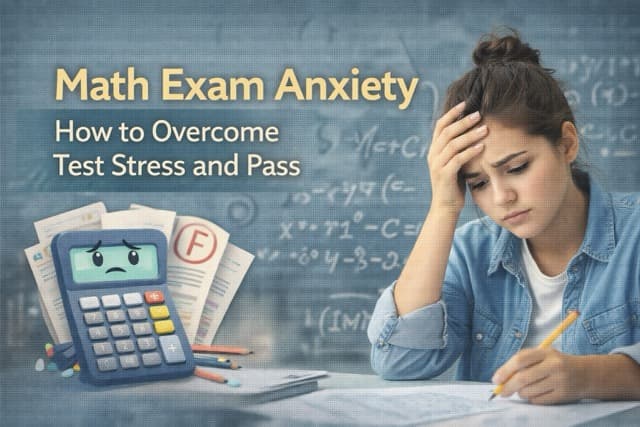
Your palms are sweating. The clock is ticking. You stare at the first question on your math exam and suddenly everything you studied last night just... vanishes. If that sounds familiar, you're dealing with math exam anxiety - and honestly, you're far from alone in this.
Here's something that might surprise you: roughly 93% of adults in the U.S. report experiencing some level of math anxiety, according to research published in the journal PLOS ONE. That's not a small number. We're talking about a near-universal experience that affects everyone from high school students to working professionals taking certification exams like the GRE, GED, or Praxis.
The good news? Math test anxiety isn't some permanent character flaw. It's a learned response - which means it can be unlearned. In this guide, we'll break down exactly why math makes your brain go haywire under pressure, how to spot the warning signs, and most importantly, what actually works to overcome it so you can pass your next exam with confidence.
What Is Math Anxiety (and Why It Feels So Overwhelming)
So, what is math anxiety exactly? It's not just disliking math or finding it boring. It's a genuine emotional and physiological response - tension, apprehension, sometimes outright dread - that interferes with your ability to work with numbers. Researchers have been studying this since the 1950s, and the consensus is pretty clear: math anxiety is a real thing with measurable effects on brain function and test performance.
When you experience math test stress, your brain's threat detection system (the amygdala, if you want to get technical) kicks into high gear. It diverts resources away from your working memory - the same cognitive workspace you need for solving equations and interpreting word problems. So you're not imagining that you "go blank" during math exams. Your brain is literally redirecting processing power from problem-solving to panic response.
And here's the cruel irony: the harder you try to push through, the worse it gets. Anxiety occupies working memory, which makes math harder, which creates more anxiety, which eats up more working memory. It's a feedback loop that can spiral fast, especially under timed conditions.
Is math anxiety a real thing in a clinical sense? While it's not a standalone diagnosis in the DSM-5, it's recognized by psychologists and educators as a distinct form of specific anxiety that significantly impacts academic and professional performance. Researchers at the University of Chicago found that math anxiety activates the same brain regions associated with physical pain. Let that sink in - for some people, opening a math textbook triggers the same neural pathways as stubbing a toe.
Why Math Triggers More Anxiety Than Other Subjects
Nobody talks about "history exam anxiety" or "English test stress" with the same urgency. So why does math get its own category of dread? A few reasons, actually.
First, math feels uniquely unforgiving. In an English essay, you can argue your point from different angles and still get partial credit. In math, the answer is either right or wrong. That binary nature creates a high-stakes feeling even on low-stakes problems. You're not just answering a question - you're either succeeding or failing, with nothing in between.
Second, math builds on itself in a way other subjects don't. Miss one concept in algebra, and it haunts you through calculus. Forget a key formula on the GED math section and suddenly three questions are unsolvable. That cumulative nature means knowledge gaps compound over time, and many students carry unresolved confusion from years ago into their current exams.
Third - and this is a big one - cultural messaging. How many times have you heard someone say "I'm just not a math person" like it's a genetic trait? That narrative is everywhere, and research shows it becomes a self-fulfilling prophecy. Math anxiety in adults often traces back to early classroom experiences where a teacher's frustration or a parent's offhand comment planted the seed that math ability is innate rather than developed.
Finally, time pressure amplifies everything. Most math exams are timed, and the combination of complex problem-solving under a countdown creates a perfect storm for anxiety. Your brain interprets the ticking clock as a threat, triggering fight-or-flight responses that are spectacularly unhelpful when you need to calculate compound interest or factor polynomials.
How to Recognize Math Test Anxiety in Yourself
Math test anxiety doesn't always look like a full-blown panic attack. Sometimes it's subtler, and recognizing the signs early is the first step toward managing them. Here's what to watch for:
Physical Symptoms
- Racing heart or elevated pulse when you sit down to study math
- Sweaty palms, nausea, or stomach discomfort before or during exams
- Muscle tension - especially in your neck, shoulders, and jaw
- Shallow, rapid breathing that you might not even notice
- Headaches that conveniently appear right before math study sessions
Cognitive Symptoms
- Going blank on material you definitely studied and knew
- Difficulty concentrating or reading questions thoroughly
- Negative self-talk ("I can't do this," "I'm going to fail")
- Racing thoughts that jump between questions instead of focusing on one
- Second-guessing answers you were initially confident about
Behavioral Symptoms
- Procrastinating on math homework while completing other subjects first
- Avoiding courses or career paths that involve math
- Rushing through math problems to "get it over with"
- Leaving exam questions blank rather than attempting them
- Spending excessive time on easy problems because the hard ones feel paralyzing
If you recognized yourself in several of those bullets, you're likely dealing with some degree of math exam anxiety. The severity can range from mild discomfort to extreme math anxiety that completely derails performance. Either way, the strategies ahead can help.
7 Proven Strategies to Overcome Math Exam Anxiety
Alright, here's where things get actionable. These math test anxiety strategies come from cognitive behavioral research, educational psychology, and real-world experience helping thousands of students pass exams they once thought were impossible.
1. Reframe Your Relationship with Math
This sounds vaguely self-help-y, but bear with me - the science is solid. Stanford psychologist Jo Boaler's research demonstrates that students who view math ability as something you develop (growth mindset) outperform those who see it as fixed talent, even when starting from lower skill levels.
Practically speaking, this means catching yourself when you think "I'm bad at math" and replacing it with something more accurate: "I haven't found the right approach yet" or "this specific concept needs more work." It's not toxic positivity - it's recognizing that struggle is part of learning, not evidence of failure.
2. Build Fluency Before the Exam, Not During It
A huge chunk of math test stress comes from encountering problems that feel unfamiliar under pressure. The fix? Overlearn the fundamentals through spaced repetition. When basic operations become automatic, your working memory is freed up for actual problem-solving rather than arithmetic panic.
This is particularly relevant for standardized exams like the Praxis math section or the GRE quantitative reasoning, where the questions themselves aren't necessarily harder than what you've seen before - they're just wrapped in unfamiliar formats that trip you up when anxiety is already running high.
3. Practice Under Realistic Conditions
Studying in a quiet room with unlimited time is great for learning concepts. But it does almost nothing to prepare you for the anxiety of a timed, high-stakes exam. You need to simulate the actual testing environment - timer running, no phone, no breaks.
Start with low-pressure timed sessions and gradually increase the stakes. Do a practice test at the library instead of your couch. Time yourself strictly. The goal is desensitization - making the test environment feel familiar rather than threatening. Your brain can't panic about something it's done a hundred times.
4. Learn Anxiety-Specific Breathing Techniques
This is the one strategy almost everyone skips because it feels too simple. But physiological regulation through breathing is one of the fastest ways to interrupt the anxiety-performance spiral.
The technique that works best for exam settings is the 4-7-8 method: breathe in for 4 seconds, hold for 7, exhale for 8. Two or three cycles can meaningfully reduce your heart rate and cortisol levels. You can do it sitting at your desk without anyone noticing. It doesn't solve the math problem, but it gives your working memory a fighting chance by calming down the threat response that's hogging all your cognitive resources.
5. Use an "Anxiety Dump" Before Starting
Research from the University of Chicago found that students who spent 10 minutes writing about their exam worries before a math test actually performed better than those who didn't. The theory is that expressive writing offloads anxious thoughts from working memory, freeing up cognitive space for actual problem-solving.
Before your next math exam, take a few minutes to write out every worry rattling around in your head. "I'm scared I'll forget the quadratic formula." "What if I run out of time?" Get it all out on paper. It sounds counterintuitive - why focus on the scary stuff? - but the research consistently shows it works by giving your brain permission to let go of those thoughts.
6. Get Targeted Help for Your Specific Gaps
Here's something a lot of students don't realize: math anxiety and math skill gaps feed each other. You're anxious partly because there are genuine concepts you haven't mastered, and those gaps make every exam feel more threatening. Fix the gaps, and a significant portion of the anxiety dissolves on its own.
Generic studying won't cut it, though. You need diagnostic-driven preparation that identifies exactly where your knowledge breaks down. Our GED tutoring service and Praxis tutoring use AI diagnostics to pinpoint the specific math concepts tripping you up, then expert tutors address those gaps in focused sessions. When you actually understand the material - deeply, not surface-level - the anxiety loses much of its power.
7. Build a Pre-Exam Routine You Can Count On
Athletes have pre-game rituals for a reason. Routines signal to your brain that you're entering a familiar, manageable situation rather than an unpredictable threat. Build your own math exam routine: same breakfast, same warm-up problems, same breathing exercises, same self-talk scripts.
The content of the routine matters less than the consistency. Your nervous system learns "we've been here before, and we were fine." Over time, this association becomes powerful enough to significantly dampen the anxiety response before it spirals.
💡 Struggling with Math on a Certification Exam?
Don't let math anxiety stand between you and your career goals.
Our AI-powered diagnostic identifies your exact math weak spots, then expert tutors fix them in one focused session. Available for the GRE, GED, Praxis, and more - with a pass guarantee or your money back.
Exam Day: What to Do When the Panic Hits
You've studied, you've practiced, you've got your breathing technique ready. But what happens when you sit down, open the test booklet, and your mind goes blank anyway? Because let's be honest - that happens to even the most prepared students sometimes.
The First 5 Minutes Are Critical
Don't start answering questions immediately. Spend the first two minutes scanning the entire exam. Get a feel for what's coming. This preview eliminates the "what's next" anxiety that builds as you work through unfamiliar territory. Mark questions that look straightforward - you'll start with those to build momentum and confidence.
Use the "Easy First" Strategy
Answer every question you know first, regardless of order. Skip anything that makes you hesitate for more than 30 seconds. This isn't giving up - it's smart allocation of your cognitive resources. Each correct answer builds confidence, which reduces anxiety, which frees up working memory for the harder problems when you circle back.
When You Freeze, Reset
If panic hits mid-exam, put your pencil down. Do your breathing technique (4-7-8, remember?). Then look at the problem again with fresh eyes. Sometimes just the act of physically stopping - breaking the spiral - is enough to let your working memory come back online.
Another trick that works surprisingly well: if you're stuck on a problem, write down literally everything you know about it. The relevant formula. What the question is asking. What information you're given. Sometimes the act of writing activates retrieval pathways that panic had blocked. You knew this stuff - your brain just needs a different access point.
"I'd been avoiding math my entire adult life. Failed the GED math section twice. But once I understood that my problem wasn't stupidity - it was anxiety eating up my working memory - everything changed. Got targeted help for the specific concepts I was fuzzy on, practiced the breathing techniques, and passed on my third attempt with a score I never thought possible."
— Marcus T., GED Test Taker
When Self-Help Isn't Enough - Getting Professional Support
The strategies above work for most people with mild to moderate math test anxiety. But for some, extreme math anxiety goes deeper. If math-related dread is affecting your daily life, career choices, or mental health beyond just exam situations, it might be worth talking to a professional.
Cognitive behavioral therapy (CBT) has strong evidence for treating math anxiety specifically. A therapist can help you identify and challenge the deeply rooted beliefs driving your anxiety - things like "I'll never be good enough" or "everyone will see I'm faking it" that go beyond simple test nerves.
For the exam-specific side, targeted tutoring that addresses both the emotional and academic components of math anxiety can be transformative. Our GRE tutoring and GED tutoring services pair AI-driven diagnostics with expert tutors who understand that math performance isn't just about knowing formulas - it's about managing the psychological barriers that prevent you from applying what you know.
There's no shame in getting help. Actually, recognizing that anxiety is the bottleneck - not intelligence - is arguably the smartest thing you can do. You've probably been fighting math on two fronts this whole time: the actual content and the emotional response. Why not get support for both?
Frequently Asked Questions About Math Exam Anxiety
Is math anxiety a real thing?
Yes, absolutely. Math anxiety is a well-documented psychological phenomenon backed by decades of research. Studies using brain imaging have shown that math anxiety activates pain-related regions of the brain. It's not laziness, it's not being dramatic, and it's not "just hating math." It's a measurable stress response that genuinely impairs cognitive function during mathematical tasks.
Can you overcome math anxiety as an adult?
Definitely. Math anxiety in adults is very treatable through a combination of cognitive reframing, skill-building, and gradual exposure to math in low-pressure environments. Many adults discover that their anxiety stemmed from poor early math instruction rather than any lack of ability. With the right approach and support, adults often make faster progress than they expect because they bring life experience and motivation that younger students lack.
How do I stop going blank during math exams?
"Going blank" happens when anxiety floods your working memory. The most effective math test anxiety tips for this include: practice under timed conditions to desensitize yourself, use the 4-7-8 breathing technique when panic hits, do an "anxiety dump" (write your worries on scrap paper) before starting, and tackle easy questions first to build confidence. If you consistently blank on specific topics, that's a signal to get targeted help on those concepts through a service like our Praxis math tutoring or GRE prep.
Does math anxiety mean I'm bad at math?
No. This is one of the most common misconceptions, and it's important to separate the two. Plenty of people who are objectively competent at math still experience significant anxiety around it. The anxiety is about the emotional response to math, not your actual mathematical ability. In fact, research suggests that reducing math test anxiety alone - without any additional math instruction - can improve test scores by up to a full letter grade.
What's the difference between math anxiety and test anxiety?
They often overlap, but they're distinct. General test anxiety affects performance across all subjects, while math exam anxiety is specifically triggered by mathematical content and tasks. Some people experience both, but many find that their anxiety is exclusively math-related. If you breeze through your English finals but dissolve into panic during algebra midterms, you're likely dealing with math-specific anxiety rather than a general testing issue.
How long does it take to overcome math anxiety?
It varies, honestly. Some students see significant improvement within a few weeks of applying math test anxiety strategies consistently. Deep-rooted anxiety that's been building for years may take longer to fully resolve. The key is starting with small, manageable steps - don't try to conquer calculus overnight. Build confidence through progressively challenging material, celebrate small wins, and remember that setbacks are normal parts of the process.
Can medication help with math exam anxiety?
In some cases, yes. A doctor might prescribe short-term anti-anxiety medication for severe exam anxiety, particularly if it's preventing you from completing an important certification test. But medication alone isn't a long-term solution - it works best when combined with the behavioral and cognitive strategies we discussed. Always consult with a healthcare provider rather than self-medicating.
Don't let math anxiety hold you back from the score you need. Get targeted, expert help today.
Get Expert Math Exam Help Now →You Can Beat Math Anxiety - Here's Your Next Step
Let's recap what we covered: math exam anxiety is a real, scientifically validated condition that hijacks your working memory and sabotages performance - regardless of how much you actually know. It's fueled by math's unforgiving nature, cumulative skill structure, cultural messaging, and time pressure. But it's absolutely beatable.
The seven strategies - reframing your mindset, building fluency, practicing under real conditions, breathing techniques, anxiety dumps, targeted gap-fixing, and pre-exam routines - give you a comprehensive toolkit for overcoming math anxiety at every level. Combined with exam-day techniques like the "easy first" approach and mid-panic resets, you have everything you need to reclaim your math performance.
But here's the thing that separates people who just read articles from people who actually pass: taking action. If you've got a math exam coming up - whether it's the GRE, the GED, the Praxis, or any other certification with a math component - don't just manage the anxiety. Fix the underlying gaps that feed it.
Our AI diagnostic pinpoints exactly where your math knowledge breaks down, and expert tutors address those specific gaps in a single focused session. Pass guarantee or your money back. Because the fastest way to reduce math test stress is to actually know the material cold - and the fastest way to get there is targeted, diagnostic-driven preparation rather than months of generic studying.
✅ Stop Fighting Math Anxiety Alone
AI diagnostics + expert tutoring + pass guarantee = confidence on exam day.
Related Exam Prep Resources
Struggling with math on a specific exam? Check out our targeted study guides and prep resources:
- GED Math Practice Test: Free Questions and Expert Tips
- Praxis Core Math Study Guide: 5 Proven Strategies to Pass
- HESI Math Section: Complete Guide and Practice Problems
- How to Improve GRE Verbal Score: 7 Expert-Backed Strategies
- Fast GRE high score tutoring - graduate school exam mastery
- Fast GED pass tutoring - pass the GED math section with confidence
All our exam prep services combine AI-powered diagnostics with expert human tutoring and a pass guarantee. If math anxiety has been holding you back, it's time to break the cycle.