If the ACT Science section keeps wrecking your composite score, you're definitely not alone. The good news? You don't need a chemistry degree to crush it. You need the right ACT science tips and strategies—and a way to use the 35 minutes the test gives you.
Most students walk into ACT Science expecting a biology pop quiz. What they actually get is a reading-and-graph-interpretation test wearing a lab coat. That mismatch is exactly why bright students with solid GPAs sometimes bomb this section. They study content. They never learn how the section is actually scored.
This guide breaks down the act science section strategies that move scores fastest: passage attack order, the data-first method, pacing math, and conflicting viewpoints shortcuts. We'll cover how to pass ACT Science whether you have three months or three days to prep, and we'll point you to the fastest shortcut at the end—an AI-driven 1-hour ACT tutoring system with a guaranteed score boost. Let's get into it.
Why the ACT Science Section Trips Up Smart Students
Here's the uncomfortable truth about ACT Science: it punishes people who actually know science. Students who took AP Bio or AP Chem often slow down trying to "really understand" each experiment. They read every paragraph. They study every variable. And then the timer hits zero with a passage and a half still untouched.
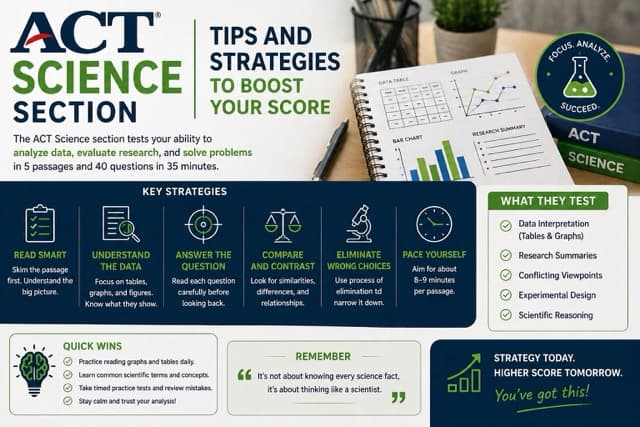
The section throws six or seven passages at you in 35 minutes. Do the math—that's roughly five minutes per passage, including the questions. There is no way to read every word and finish. So the test isn't really measuring what you know about photosynthesis or Newton's laws. It's measuring whether you can find a number on a chart, fast.
That's the first mindset shift you need: ACT Science is a data-interpretation test that sometimes uses scientific topics as wallpaper. Once you see it that way, the right act science prep approach starts making sense.
What ACT Science Actually Tests (Hint: It's Not Science)
According to ACT's official description, the Science section tests three skills: interpretation of data, scientific investigation, and evaluation of models, inferences, and experimental results. Notice what's missing? Memorized content.
You'll occasionally see a question that requires outside knowledge (water boils at 100°C, photosynthesis uses sunlight, that kind of thing), but those questions are rare—usually three or four out of forty. The other 36+ questions can be answered straight from the passage if you know where to look.
That changes the whole study plan. Memorizing the periodic table won't move your score. Learning to scan a graph in fifteen seconds absolutely will. This is why traditional act science study guide approaches—the ones with hundreds of pages of content review—often waste your time. You need drills, not textbooks.
The 3 Types of ACT Science Passages You'll See
Every ACT Science passage falls into one of three categories. Knowing which type you're looking at—within five seconds of opening to it—is half the battle.
Data Representation (The Easiest)
These passages show you charts, tables, and graphs with minimal text. Your job is to read the visuals. That's it. Most students who learn to ignore the explanatory text and go straight to the data find these passages quick wins. Aim to finish each Data Rep passage in under four minutes.
Research Summaries (The Most Common)
You'll get two or three of these. They describe a series of experiments—usually 2 to 3 studies tied together by a common theme. Questions ask you to compare results across experiments, identify variables, or predict what would happen if conditions changed. The trap here is reading every experiment in detail. Don't. Skim the setup, then attack the questions.
Conflicting Viewpoints (The Time Killer)
One passage on every test. Two or three scientists present opposing hypotheses about the same phenomenon. This is the only passage that's essentially a reading test, and it's the single biggest reason students run out of time. We'll handle it specifically in Strategy #3 below.
Quick tip: when the section starts, flip through and find the Conflicting Viewpoints passage immediately. Some test-takers save it for last because it eats time disproportionately. Others attack it first while their brain is fresh. Either is fine—just don't get ambushed by it in the middle.
Strategy #1: The Data-First Attack Method
This is the single most effective change you can make to your act science section tips playbook. Stop reading the passage first. Start with the figures.
Open the passage. Glance at the title. Then jump straight to Figure 1, Table 1, or whatever visual shows up. Spend 20 seconds decoding axes, units, and trends. Look at what increases, what decreases, and what stays flat. Then go to the questions.
Roughly 70% of ACT Science questions can be answered using only the figures. You don't need the experimental design narrative. You don't need to know why the scientists ran the study. You need to find the value at point X on chart Y. That's pattern recognition, not science knowledge.
How to Read an ACT Science Graph in 15 Seconds
Here's the drill we run with students in our fast ACT pass tutoring sessions. Cover the questions. Open to a random Data Rep passage. Set a 15-second timer. In that window, identify: (1) what's on the x-axis, (2) what's on the y-axis, (3) the unit of measure, (4) one trend you notice. Practice this 20 times and your graph-scanning speed will roughly double.
That speed compounds across forty questions. A student who saves ten seconds per question gains six and a half minutes back—enough to finish the section instead of guessing on the last passage.
When to Actually Read the Passage
Read the text only when a question forces you to. Look for keywords like "according to the experimental design" or "based on the hypothesis described in Study 2." That's your signal to dip back into the prose. Otherwise, stay in the data.
Strategy #2: Master the Pacing Math (35 Minutes, 40 Questions)
Pacing wins or loses ACT Science. The math is brutal: 35 minutes, roughly 6-7 passages, 40 questions. That works out to about 52 seconds per question or 5 minutes per passage. If you blow your time budget on any single passage, you'll either rush the rest or run out.
The 5-Minute Passage Budget
Wear an analog watch (one with hands you can read at a glance). Set it to 12:00 when the section starts. Each passage gets five minutes. When the minute hand hits the 1, you must move on—even if you have one question left. You'll get more points by attempting all forty questions than by perfecting any single passage.
The "Skip and Return" Rule
If a question takes more than 90 seconds, circle it and move on. ACT Science doesn't reward stubbornness. There's no partial credit, no bonus for the hardest question, and the easiest questions are scattered throughout—often the second-to-last question on a passage is easier than the second one. Snipe the easy ones first. Come back for the hard ones if you have time.
Last 5 Minutes: Bubble Everything
Never leave a blank. The ACT doesn't penalize wrong answers, so an unbubbled question is just throwing away points. With five minutes left, do a "bubble check"—make sure every question has an answer, even if it's a guess. Statistically, picking the same letter for everything you don't know (everyone has a favorite—say, C) gives you about a 25% hit rate, which can be three or four extra points.
Strategy #3: Crack Conflicting Viewpoints Without Reading Everything
The Conflicting Viewpoints passage is where most students hemorrhage time. Two scientists, sometimes three, each lay out a theory. Then come the questions: which would Scientist 1 agree with? What's the key difference between Hypothesis 2 and Hypothesis 3?
Here's the trick: don't try to understand the science. Try to understand the disagreement. Find the one or two specific points where the scientists differ. Underline those. Most questions target exactly those friction points.
The "Compare and Contrast" Read
Read Scientist 1's passage in full—about a minute. Then for Scientist 2, only read what's different. Skim what's identical. Most of these passages share 60-70% of their setup; the scientists agree about basic facts and disagree only on interpretation. By the time you reach Scientist 2, you only need to find their twist.
Reverse-Engineer Questions
Many Conflicting Viewpoints questions can be answered by working backward from the answer choices. If three answers describe Scientist 1's view and one doesn't, you've found your Scientist 2 question without needing to fully understand either side. This is an underrated act science tips and tricks move that experienced tutors teach but most prep books skip entirely.
Last-Minute ACT Science Tips for Test Day
If your test is in a week (or, honestly, three days), here are the highest-leverage moves. These last minute act science tips won't replace months of practice, but they will move your score:
- Drill three Data Rep passages back-to-back under a 12-minute timer. You're training speed, not learning content.
- Memorize four facts: water boils at 100°C and freezes at 0°C, pH below 7 is acidic and above 7 is basic, and osmosis moves water from low solute to high solute. These cover roughly 80% of the outside-knowledge questions.
- Practice with the official ACT practice tests. Third-party prep books have stylistic differences. Get the real thing from the official ACT prep page.
- Bring a watch. Test centers don't always have visible clocks. Pacing falls apart without one.
- Eat protein for breakfast. Sounds silly. Isn't. Science is the fourth section, and your blood sugar will be tanking by then if you ate cereal at 6 a.m.
One more thing: the ACT runs Science last, after English, Math, and Reading. By the time you get there, your brain is fried. Plan for that. In the days before the test, do at least one full timed practice exam in order so your stamina catches up.
Fast-Track Your Score with 1-Hour ACT Tutoring
Reading about strategy is one thing. Watching an expert apply it to your specific weaknesses is another. If you've been grinding practice tests and your Science score isn't budging, the issue isn't usually effort—it's diagnosis. You don't know which of the above strategies you're failing to execute.
Our fast ACT pass tutoring service uses an AI diagnostic to figure out exactly where your Science points are leaking, then pairs you with a certified ACT tutor for one focused hour. Most students gain 3-5 composite points after one session, and we back it with a money-back guarantee. If your score doesn't improve, you don't pay.
💡 Fast ACT Pass Guarantee
1 Hour. Expert ACT Tutor. AI Diagnostics. Score Boost or Refund.
Stop guessing at which act science strategies you're missing. Get a personalized diagnostic that pinpoints your score limiters in 15 minutes—then fix them in one session.
See how 1-hour ACT tutoring works →"Went from a 24 to a 32 after one session. The tutor figured out I was losing almost all my points on Science because I was trying to read every passage word-for-word instead of going straight to the data. That one strategy change was worth 4 composite points alone."
— Jordan M., ACT Composite 32 (from 24)
Frequently Asked Questions About ACT Science
How do I pass the ACT Science section if I'm bad at science?
Good news: ACT Science doesn't really test science knowledge. It tests data interpretation. Most questions can be answered by reading charts and tables, not by recalling biology or chemistry facts. Focus your act science prep on graph reading, pacing, and the data-first attack method instead of content review. Students with weak science backgrounds often score higher than AP students once they learn the format.
How many questions are on the ACT Science section?
The ACT Science section has 40 questions and a 35-minute time limit, spread across 6 or 7 passages. That gives you roughly 52 seconds per question or about 5 minutes per passage. Pacing is the single biggest factor that separates a 24 from a 30 on this section.
What are the 3 types of ACT Science passages?
The three passage types are Data Representation (charts and graphs only, easiest), Research Summaries (multiple linked experiments, most common), and Conflicting Viewpoints (competing scientific theories, most time-consuming). Knowing which type you're attacking determines your strategy. Data Rep and Research Summaries should take roughly 4-5 minutes each. Conflicting Viewpoints often runs 6-7 minutes.
How can I improve my ACT Science score quickly?
The fastest gains come from three changes: (1) read figures before passages, (2) wear an analog watch and budget five minutes per passage, and (3) skip questions that take longer than 90 seconds and return to them. Combined with our 1-hour AI-driven ACT tutoring, students typically see 3-5 point composite improvements—even with limited time before test day.
Is the ACT Science section just a reading test?
Mostly, yes—with charts and tables instead of paragraphs. The scientific topics are essentially backdrop. You're being tested on whether you can extract information quickly, compare data sets, and identify patterns. That's why tips for the science section of the act focus on visual scanning skills rather than content mastery.
How much outside science knowledge do I need?
Very little. Roughly 3-4 questions out of 40 require outside knowledge, and the topics are usually high-school basics: states of matter, pH scale, basic biology terms, simple physics laws. Memorizing a one-page cheat sheet of common facts covers nearly all of these questions. The other 36 questions are pure data interpretation.
Should I do ACT Science first or last?
The ACT format puts Science fourth, so you don't have a choice during the actual exam. But within the section, many students attack the Conflicting Viewpoints passage first while their brain is fresh, then move to Data Representation passages, then finish with Research Summaries. Try this order in practice and see if it works for you.
Ready to boost your ACT Science score? Book your 1-hour guaranteed tutoring session today.
Get Your Guaranteed ACT Score Boost →Your Path to a Higher ACT Science Score
Here's what to take away. ACT Science isn't a science test—it's a timed data-interpretation test. The students who crush it aren't the ones who know the most chemistry. They're the ones who read charts fast, manage time ruthlessly, and don't let Conflicting Viewpoints eat their clock.
Apply the data-first attack method. Stick to the 5-minute passage budget. Skip questions that drag past 90 seconds. Bubble everything before time runs out. These four habits alone will move most students 2-4 composite points without touching a single new piece of content.
And if you want to compress months of trial and error into one focused session, our fast ACT pass tutoring service was built exactly for that. AI diagnostics find your specific weak spots, an expert tutor fixes them in an hour, and a money-back guarantee means there's no real downside to trying.
Whichever route you take—self-study or guided coaching—stop studying ACT Science like it's a biology class. Start studying it like the speed game it actually is. That single mindset shift is often worth more points than any specific strategy in this guide.
✅ Your Guaranteed ACT Score Boost Awaits
AI diagnostics + expert ACT tutoring + score guarantee = your fastest path to a higher composite.
Start Your 1-Hour ACT Tutoring Session →Related Exam Prep Resources
Working on more than just the ACT? Explore our other proven exam prep guides and tutoring services:
- SAT vs ACT: Which Test Should You Take? — pick the right exam for your strengths.
- How to Improve Your SAT Score by 200 Points — proven score-boost strategies.
- Fast ACT pass tutoring — guaranteed composite score improvement.
- Fast GRE high score tutoring — graduate school exam mastery.
Every ParityX exam prep service uses the same AI diagnostic + expert tutoring methodology, with the same pass guarantee. Don't score where you wanted? You don't pay. Simple as that.